
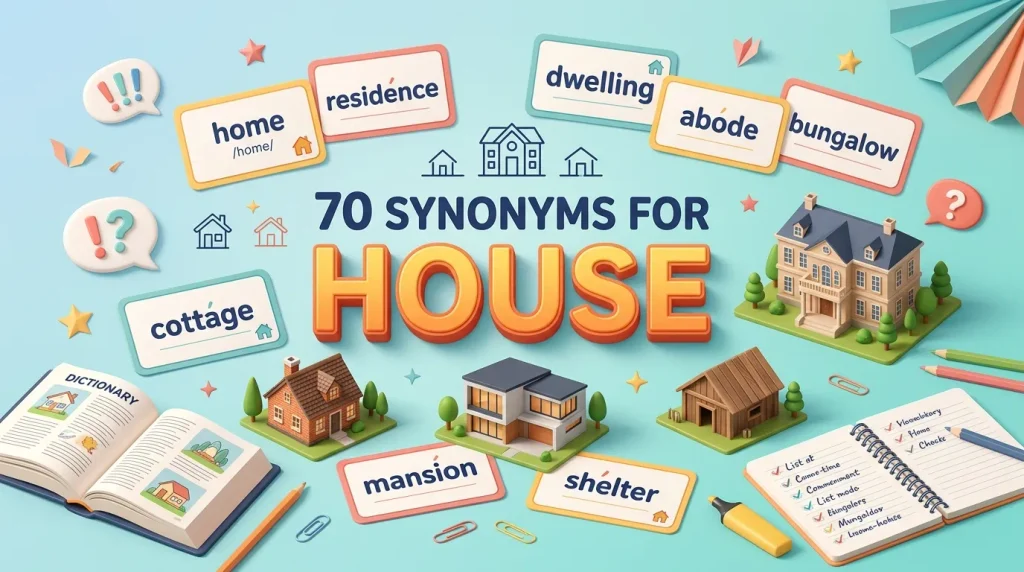
Synonyms for house include home, dwelling, residence, abode, domicile, cottage, cabin, bungalow, and villa. These words describe the places where people live, from humble shelters to grand estates. The best choice depends on size, style, formality, and the feeling you want to create.
Imagine you are helping a friend sell a small lakeside property. You could call it a house, but that single word tells the buyer nothing about the creak of the wooden porch, the smell of pine in the air, or the way morning light spills across the water.
Call it a cottage, and suddenly the buyer can picture it. Call it a cabin, and the mood shifts again, more rugged, more remote. One small word choice changes the entire picture, and that is the quiet power of synonyms.
The word house appears everywhere in daily life. It shows up in emails about rentals, in stories that need a setting, in essays about architecture or family life, in casual conversations about moving, and in social posts celebrating a new set of keys.
Because it is so common, it quickly turns invisible. Repeating house five times in one paragraph dulls the writing, while a well chosen synonym keeps every sentence fresh.
English offers an unusually rich shelf of alternatives for this simple word. Some are formal, like domicile and residence. Some are warm, like home and nest. Some carry history, like manor and chateau, while others carry slang and street energy, like pad and crib. Learning when to use each one is a skill that pays off in every kind of writing, and this guide walks you through all fifty.
Students can use these words to make essays and assignments more vivid and precise.
Bloggers can use them to avoid repetition and keep readers engaged.
Content writers can choose the exact term that matches a property listing or travel article.
Daily English users can speak more naturally by picking the word that fits the moment.
Before we dive into the full list, let us look at how to pick the right word, and then explore each synonym with its meaning and an example.
“A house becomes a home the moment your words give it warmth.”
“Describe the dwelling well, and the reader will want to live there.”
How to Choose the Right Synonym for House
Start with formality. In legal or official writing, domicile and residence are the safe choices, since they sound precise and neutral. In a friendly email or a novel, abode, cottage, or nest feel warmer and more human. Slang like pad, crib, and digs belongs in casual conversation or dialogue, never in a contract or a formal report.
Next, watch the connotation. Cottage suggests charm, while shack suggests poverty. Mansion promises luxury, while hovel promises misery. Two words can describe the same building size yet paint opposite pictures, so ask yourself what feeling you want the reader to take away.
Finally, match the context. A travel article about the Alps calls for chalet, a piece on New York real estate calls for brownstone or townhouse, and a historical novel might need manor, grange, or parsonage. The setting often chooses the word for you.
When in doubt, read the sentence aloud. If the synonym sounds natural in the sentence, it is probably right. If it draws attention to itself, try a simpler option like home or house itself. Clarity always beats cleverness.
70 Synonyms for House
1. Home
Meaning: A home is a house filled with personal warmth and belonging, the place where you feel most yourself.
Examples: After years abroad, she finally returned home for the holidays.
2. Dwelling
Meaning: A dwelling is a formal word for any place where people live.
Examples: The census recorded every dwelling in the district.
3. Residence
Meaning: A residence is an official or upscale term for someone’s house.
Examples: The ambassador’s residence sits behind high stone walls.
4. Abode
Meaning: An abode is a slightly literary word for a home or dwelling.
Examples: Their countryside abode was quiet and full of books.
5. Domicile
Meaning: A domicile is a legal term for a person’s permanent home.
Examples: For tax purposes, his domicile remained the family house.
6. Lodging
Meaning: Lodging refers to a temporary place to stay, often rented.
Examples: The travelers found lodging at a small inn near the harbor.
7. Habitation
Meaning: Habitation means a place used as a dwelling, often in formal writing.
Examples: Archaeologists found traces of ancient habitation in the valley.
8. Homestead
Meaning: A homestead is a house with surrounding land, often a family farm.
Examples: Her grandparents built their homestead with their own hands.
9. Cottage
Meaning: A cottage is a small, cozy house, often in the countryside.
Examples: They spent the weekend in a thatched cottage by the lake.
10. Cabin
Meaning: A cabin is a small, simple house, usually made of wood.
Examples: He built a log cabin deep in the pine forest.
11. Bungalow
Meaning: A bungalow is a low house with all rooms on one floor.
Examples: The retired couple bought a sunny bungalow near the beach.
12. Villa
Meaning: A villa is an elegant, often spacious house, sometimes used as a holiday home.
Examples: They rented a white villa overlooking the sea.
13. Mansion
Meaning: A mansion is a very large and impressive house.
Examples: The old mansion on the hill had forty rooms.
14. Chalet
Meaning: A chalet is a wooden house with a sloping roof, typical of Alpine regions.
Examples: Their chalet glowed warm against the snowy slopes.
15. Lodge
Meaning: A lodge is a sturdy house, often in the woods or mountains, used for holidays or hunting.
Examples: The fishing lodge welcomed guests every autumn.
16. Manor
Meaning: A manor is a large country house with land around it.
Examples: The manor had belonged to the same family for centuries.
17. Estate
Meaning: An estate is a large property that includes a grand house and grounds.
Examples: The estate employed dozens of gardeners.
18. Farmhouse
Meaning: A farmhouse is the main dwelling on a farm.
Examples: The old farmhouse smelled of fresh bread and wood smoke.
19. Townhouse
Meaning: A townhouse is a tall, narrow house in a city, sharing walls with neighbors.
Examples: Their brick townhouse stood three stories high.
20. Penthouse
Meaning: A penthouse is a luxurious apartment on the top floor of a building.
Examples: From the penthouse, the whole city glittered below.
21. Apartment
Meaning: An apartment is a set of rooms forming a home within a larger building.
Examples: She rented a bright apartment downtown.
22. Flat
Meaning: A flat is the British term for an apartment.
Examples: His flat overlooked a busy London street.
23. Condo
Meaning: A condo is short for condominium, an individually owned unit in a shared building.
Examples: They bought a condo with a view of the marina.
24. Duplex
Meaning: A duplex is a house divided into two separate living units.
Examples: The duplex gave each brother his own entrance.
25. Tenement
Meaning: A tenement is a large building divided into small, modest apartments.
Examples: The old tenements told stories of immigrant families.
26. Terrace
Meaning: A terrace is a house joined to a row of identical houses.
Examples: Their terrace had a tiny garden out back.
27. Semi
Meaning: A semi is short for a semi-detached house, joined to one neighbor.
Examples: They grew up in a friendly semi on a quiet street.
28. Ranch
Meaning: A ranch is a long, low, single-story house, popular in America.
Examples: The ranch stretched wide across the desert lot.
29. Hut
Meaning: A hut is a small, simple shelter.
Examples: The fisherman’s hut stood alone on the rocky shore.
30. Shack
Meaning: A shack is a roughly built, humble dwelling.
Examples: The old shack leaned against the wind by the railway tracks.
31. Shanty
Meaning: A shanty is a crudely built small house, often in a poor area.
Examples: The shanty towns grew quickly outside the city.
32. Hovel
Meaning: A hovel is a miserable, rundown dwelling.
Examples: He was born in a hovel but rose to build an empire.
33. Yurt
Meaning: A yurt is a round, portable tent-like dwelling used by nomads.
Examples: The family raised their yurt on the grassy steppe.
34. Palace
Meaning: A palace is a grand residence, usually for royalty.
Examples: The winter palace shimmered with gold and marble.
35. Castle
Meaning: A castle is a large fortified building, once a noble home.
Examples: The castle overlooked the river from its rocky hill.
36. Hall
Meaning: A hall can mean a large country house.
Examples: The wedding was held at the old hall beyond the village.
37. Court
Meaning: A court is a grand house or palace, often with a courtyard.
Examples: Hampton Court draws visitors from around the world.
38. Grange
Meaning: A grange is a country house with farm buildings.
Examples: The lonely grange stood at the end of a long drive.
39. Parsonage
Meaning: A parsonage is the house provided for a parish priest or minister.
Examples: The new vicar moved into the old parsonage.
40. Manse
Meaning: A manse is the residence of a minister, especially in Scotland.
Examples: The manse garden was famous for its roses.
“Every dwelling has a story, if you choose the words to tell it.”
“From hut to palace, each home deserves its own name.”
41. Hacienda
Meaning: A hacienda is a large estate house in Spanish-speaking regions.
Examples: The hacienda’s courtyard bloomed with bougainvillea.
42. Chateau
Meaning: A chateau is a French country house or castle, often grand.
Examples: The chateau overlooked endless rows of vineyards.
43. Dacha
Meaning: A dacha is a Russian country house used as a second home.
Examples: In summer, the family escaped to their dacha.
44. Rowhouse
Meaning: A rowhouse is one of a continuous row of similar city houses.
Examples: The historic rowhouses lined the cobbled street.
45. Brownstone
Meaning: A brownstone is a townhouse faced with brown sandstone, common in New York.
Examples: Their brownstone had a classic stoop out front.
46. Maisonette
Meaning: A maisonette is a small apartment on two floors within a larger house.
Examples: She loved her sunny top-floor maisonette.
47. Pad
Meaning: A pad is informal slang for someone’s home or apartment.
Examples: Come over to my pad this weekend.
48. Crib
Meaning: A crib is casual slang for a home, popular in youth culture.
Examples: He finally bought his own crib near the studio.
49. Digs
Meaning: Digs is informal British slang for rented rooms or a home.
Examples: The students found cheap digs near campus.
70. Nest
Meaning: A nest is a poetic word for a cozy, beloved home.
Examples: After the children left, the couple kept their little nest tidy and warm.
Using Synonyms for House in Writing
In descriptive writing, synonyms for house do heavy lifting. A mystery novel feels different when the detective returns to a lonely grange instead of a house. A travel blog comes alive when a farmhouse smells of bread and wood smoke rather than sitting in a plain house. Specific nouns create specific images.
In persuasive writing, the right synonym can even change value. Estate agents know this well: a small dwelling becomes a cozy cottage, and a large building becomes a grand residence. The facts stay the same, but the framing shifts the reader’s expectations.
Keep a short list of your favorites nearby while drafting. When you catch yourself repeating house, pause and pick the alternative that fits the size and mood of the place. Over a whole article, those small swaps add up to writing that feels rich and confident.
Synonyms for House in Everyday English
In everyday conversation, most people reach for home, house, apartment, or flat without thinking. These are the workhorses of daily speech, and there is nothing wrong with them. But adding a few more options makes you sound natural and fluent.
Talking about a friend’s new place? Try pad or crib for a casual tone, or nest if you want to sound affectionate. Describing a holiday stay? Cottage, cabin, or villa instantly sets the scene. Small upgrades like these make everyday English more colorful.
Regional words matter too. Flat is standard in Britain, while apartment dominates in America. Semi and terrace will be understood in the UK, while ranch and brownstone carry American flavor. Match your word to your listener.
Synonyms for House in Professional Writing
In professional contexts, precision beats poetry. Legal documents favor domicile, property reports use dwelling or residence, and corporate housing policies stick to neutral terms. These words are deliberately plain, and that neutrality is their strength.
Real estate writing is the exception that proves the rule. Here, warmth sells, so residence, villa, and townhouse appear alongside carefully chosen adjectives. Even here, honesty matters: calling a shack a villa will backfire the moment the buyer visits.
Avoid slang entirely in professional writing. Pad, crib, and digs may be fun among friends, but they undermine credibility in a report, a listing, or a business email. When the stakes are high, choose the formal term.
Synonyms for House in Creative Writing
Creative writers get the full playground. A gothic novel can unfold in a crumbling manor or a lonely grange. A fantasy epic can crown its kings in palaces and castles. A quiet literary story can unfold in a cottage, a tenement, or a humble hut, and each choice tells the reader about class, history, and mood.
Poetic options like abode and nest work beautifully in lyrical passages, while historical terms like hacienda, chateau, and dacha root a story in a specific culture. The key is consistency: once you name the dwelling, keep its character steady so the setting feels real.
Try describing the same building three ways: as a cottage, as a shack, and as a villa. Notice how the reader’s sympathy shifts each time. That exercise shows why creative writers treasure a deep shelf of synonyms.
FAQs:
What is the most formal synonym for house?
Domicile is the most formal, since it is the legal term for a permanent home. Residence is a close second and works in official writing without sounding as technical. In most formal documents, either word keeps the tone professional and precise.
What is the difference between a house and a home?
A house is the physical building, while a home is the feeling of belonging inside it. That is why nest and abode carry warmth that dwelling and domicile do not. In writing, house describes structure, while home describes emotion.
Which synonym should I use in a property listing?
Match the property: cottage for small and charming, villa for elegant, townhouse or brownstone for city homes, and residence for upscale listings. Avoid exaggeration, since buyers notice the gap between the word and the reality.
Is it okay to use slang like pad or crib in writing?
In casual writing, dialogue, and youth focused content, yes. In essays, reports, listings, or professional emails, no. Slang dates quickly and narrows your audience, so save it for moments when the tone is deliberately relaxed.
Conclusion:
From humble huts to grand palaces, the fifty words in this guide prove that house is only the beginning. Each synonym carries its own size, style, history, and feeling, and choosing well is one of the fastest ways to sharpen your English.
The habit is simple: notice when you repeat house, pause, and ask what the place is really like. Small or grand? Old or new? Warm or cold? Formal or casual? The answer points straight to the right word.
“Call it a cottage, and the reader can already smell the rain on the roof.”
Keep this list close while you write. Over time, the alternatives will come naturally, and your descriptions will grow richer without any extra effort. A strong vocabulary is built one careful choice at a time.
“The best writers do not just name a house, they make you want to live in it.”

I am James Carter, a passionate writer at SynonymNexts.com, sharing clear, useful, and engaging synonym guides to improve everyday writing.