
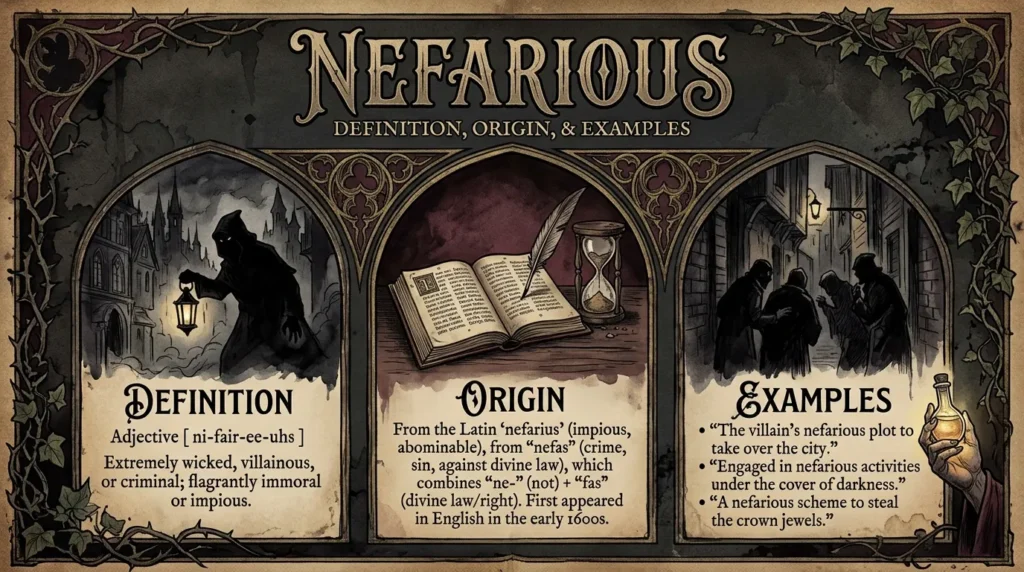
Nefarious means extremely wicked, evil, or criminal. People use the word to describe actions, plans, or people that are morally wrong, especially when the wrongdoing is deliberate and sneaky. For example, a “nefarious plot” is a secret, harmful scheme. The word is pronounced nuh-FAIR-ee-us.
Key Takeaways
- Nefarious is an adjective that describes something wicked, evil, or criminal.
- It is a strong word. It points to serious, deliberate wrongdoing, not small mistakes.
- It comes from the Latin nefas, which means “crime” or something against divine law.
- Common partners include nefarious plot, nefarious scheme, nefarious purposes, and nefarious activities.
- Close synonyms include villainous, sinister, and wicked.
What Does Nefarious Mean?
Nefarious describes something that is deeply wrong, evil, or against the law. It is not a word for small faults. Forgetting a friend’s birthday is not nefarious. Stealing from a charity and hiding it is.
Two ideas sit inside the word. The first is wrongdoing. The second is intent. A nefarious act is usually planned, and it is often done in secret. That is why you often see the word next to plot, scheme, and plan.
You can describe a person as nefarious. You can also describe actions, goals, or groups that way.
How to Pronounce Nefarious
Say it as nuh-FAIR-ee-us. The stress falls on the second syllable, “FAIR.” It has four syllables in all: ne-FAR-i-ous.
Word Forms: Nefariously and Nefariousness
- Nefarious (adjective): “a nefarious plan”
- Nefariously (adverb): “He nefariously altered the records.”
- Nefariousness (noun): “The nefariousness of the scheme shocked everyone.”
The adverb and noun forms are rare. Most people only use the adjective.
Where Does the Word Nefarious Come From?
Nefarious comes from Latin. It traces back to the noun nefas, which means “crime” or “something contrary to divine law.” Nefas joins ne- (“not”) and fas (“right” or “divine law”). So the word’s roots mean, roughly, “not right” or “against sacred law.”
English speakers have used the word since around the early 1600s. Its meaning has stayed close to the original idea of serious wrongdoing.
You may see some websites claim the word comes from a Latin root meaning “to speak.” Major dictionaries do not support that claim. They point to nefas instead.
How to Use Nefarious in a Sentence
Use nefarious when you want to show that something is seriously wrong and often secret. Here are some examples:
- The detective uncovered a nefarious plot to steal the museum’s paintings.
- Reporters investigated the mayor’s nefarious dealings with a private developer.
- The villain in the movie had a nefarious plan to take over the city.
- Hackers used the stolen passwords for nefarious purposes.
- She never suspected her business partner’s nefarious intentions.
Common Phrases With Nefarious
- nefarious plot
- nefarious scheme
- nefarious purposes
- nefarious activities
- nefarious intentions
- nefarious deeds
- nefarious character
Correct vs. Incorrect Use
| Sentence | Correct? | Why |
|---|---|---|
| The gang ran a nefarious smuggling ring. | ✅ Yes | Serious, criminal, and secret. |
| He had a nefarious plan to fake his own death and collect the money. | ✅ Yes | Deliberate and harmful. |
| My brother is nefarious because he ate the last cookie. | ❌ Not serious | Too strong, unless you mean it as a joke. |
| The weather was nefarious today. | ❌ No | Weather has no intent or morals. |
Playful Use in Everyday Speech
People often use nefarious with a wink. A parent might say, “What nefarious scheme are you two planning?” when kids whisper together. A cartoon cat knocking a glass off a table might get called nefarious.
This works because the word sounds so dramatic. If you use it playfully, make sure the tone is clear. In serious writing, such as news or legal text, it means real wrongdoing.
Nefarious Synonyms and Antonyms
Nefarious has many close synonyms. Each one has a slightly different feel.
| Synonym | Feel |
|---|---|
| Wicked | Morally bad, general use |
| Evil | Deeply harmful or cruel |
| Villainous | Like a story villain |
| Sinister | Threatening, suggests hidden danger |
| Malicious | Done to hurt someone on purpose |
| Corrupt | Dishonest, often involving power or money |
| Criminal | Against the law |
| Heinous | Shockingly terrible, often about a crime |
Antonyms include good, virtuous, honorable, righteous, noble, and benevolent.
Nefarious vs. Similar Words
A few words are easy to mix up with nefarious. Here is how they differ.
| Word | Meaning | Key Difference |
|---|---|---|
| Nefarious | Wicked, criminal, often secret | Focuses on evil acts or plans |
| Notorious | Famous for something bad | Focuses on bad reputation, not the act |
| Sinister | Suggests danger or evil ahead | Often about mood or feeling |
| Villainous | Like a villain | Often used in stories |
| Infamous | Well known for a bad reason | Reputation again, like notorious |
A simple way to remember it: notorious and infamous are about being known for bad things. Nefarious is about the bad things themselves. A person can be nefarious and completely unknown. A person can also be notorious without being truly evil, such as a famously messy roommate.
Common Mistakes to Avoid
1. Using it for minor issues. Nefarious is a heavy word. If something is only rude, silly, or annoying, a lighter word fits better, like naughty or sneaky.
2. Confusing it with notorious. As the table shows, they are not interchangeable.
3. Misspelling it. Common errors include nefarius, nefarous, and nefairious. The correct spelling is n-e-f-a-r-i-o-u-s.
4. Using it for things with no intent. Storms, accidents, and bad luck are not nefarious. The word needs a wrongdoer, or at least a wicked purpose behind the act.
5. Overusing it. Because the word is dramatic, it loses power when repeated. Save it for moments that call for it.
FAQs:
What is the meaning of nefarious?
Nefarious means extremely wicked, evil, or criminal. It describes deliberate wrongdoing, often done in secret. A nefarious plan is a harmful scheme, and a nefarious person is someone with bad or criminal intentions.
What is a nefarious person?
A nefarious person is someone who does evil or criminal things, or who plans to. The word suggests the person acts on purpose and often hides their actions. Villains in books and movies are common examples.
What is a simple example of nefarious?
“The thieves had a nefarious plan to rob the bank during the holiday.” Here, nefarious tells us the plan is criminal and harmful. It also hints that the thieves are hiding it.
What is the root of nefarious?
The word comes from the Latin nefas, meaning “crime” or “against divine law.” That noun combines ne- (“not”) and fas (“right” or “divine law”). Literally, it means something that is “not right.”
Is nefarious a bad word?
No. It is not a curse word or an insult in the rude sense. It is a regular English adjective. However, calling someone nefarious is a serious accusation, so use it with care.
What is the difference between nefarious and notorious?
Nefarious describes evil or criminal acts. Notorious describes someone or something famous for a bad reason. A hidden plot can be nefarious but not notorious, because no one knows about it yet.
Can nefarious be used humorously?
Yes. People often use it jokingly for harmless mischief, like “my nefarious plan to hide the broccoli.” The humor works because the word sounds so dramatic for such a small act.
Conclusion:
The nefarious meaning is simple: extremely wicked, evil, or criminal, often with secret and deliberate intent. It comes from the Latin nefas, meaning “crime” or something against divine law. You will most often see it in phrases like nefarious plot, nefarious scheme, and nefarious purposes.
Use it when something is truly wrong and planned. Use it with a smile when you want to be funny. And if you only need to describe a small misdeed, pick a lighter word. Now that you know what nefarious means, you will notice it in news stories, novels, and movies.

I am Ryan Wilson, a passionate writer at SynonymNexts.com, sharing clear, useful, and engaging content about words, synonyms, and language.