
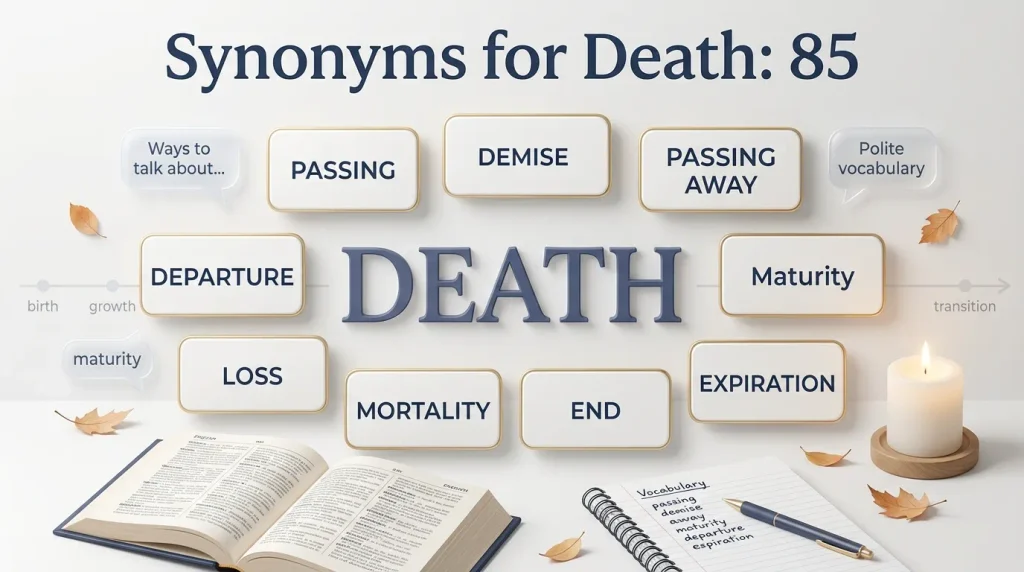
Common synonyms for death include passing, demise, end, loss, expiration, departure, and mortality. The best choice depends on the situation. Some words sound gentle and respectful, while others are formal, direct, literary, or emotional. Choosing the right synonym helps you speak and write about death with care and clarity.
The room became quiet when the family heard the sad news. Everyone searched for gentle words to share their feelings. In moments like this, the word death may feel too direct, so another word can help express the same idea with the right tone.
For example, a news report may use demise, while a family member may say passing. Both point to the same serious event, but they create different feelings.
Students can use these words to make essays more varied and thoughtful.
Bloggers can choose natural words that fit sensitive topics.
Content writers can select words that match the audience and purpose.
Daily English users can speak with more care during difficult conversations.
“Words can carry comfort when moments feel heavy.”
Learning different alternatives does not mean avoiding the truth. It means choosing language that fits the situation and respects the people involved.
“A gentle word can make a difficult message easier to hear.”
85 Death Synonym
1. Passing
- Meaning: Passing is a gentle way to talk about someone’s death.
- Examples: We were deeply saddened by her passing.
His passing left the family heartbroken.
2. Demise
- Meaning: Demise is a formal word used to describe someone’s death.
- Examples: The report confirmed his sudden demise.
Everyone mourned after hearing about her demise.
3. End
- Meaning: End can describe the final point of a person’s life.
- Examples: His life reached its peaceful end.
The story described the hero’s tragic end.
4. Expiration
- Meaning: Expiration is a formal term sometimes used for the end of life.
- Examples: The document recorded his time of expiration.
The doctor confirmed the patient’s expiration time.
5. Departure
- Meaning: Departure can gently describe someone leaving life behind.
- Examples: We remembered her peaceful departure with love.
His departure brought great sadness to everyone.
6. Loss
- Meaning: Loss describes the death of someone important to people.
- Examples: The family felt his loss deeply.
Her loss affected everyone at work.
7. Mortality
- Meaning: Mortality refers to the condition of being subject to death.
- Examples: The book explores human mortality.
The lesson discussed mortality and human life.
8. Fatality
- Meaning: Fatality refers to a death caused by an accident or event.
- Examples: The crash caused one fatality.
Officials reported another fatality yesterday morning.
9. Demise
- Meaning: Demise formally refers to the end of someone’s life.
- Examples: Newspapers reported the actor’s demise.
Fans shared memories after his demise.
10. Passing Away
- Meaning: Passing away is a respectful phrase commonly used for death.
- Examples: Her grandfather passed away peacefully.
We learned that their neighbor passed away.
11. Perishing
- Meaning: Perishing means dying, often because of danger, hardship, or violence.
- Examples: Many animals were perishing from hunger.
The plants began perishing during the drought.
12. Fatal End
- Meaning: Fatal end describes a situation that finishes with someone’s death.
- Examples: The accident brought a fatal end.
His journey had a tragic fatal end.
13. Final Breath
- Meaning: Final breath describes the last moment before someone dies.
- Examples: He took his final breath peacefully.
The nurse stayed beside him during his final breath.
14. Last Breath
- Meaning: Last breath refers to the final breath taken before death.
- Examples: She held his hand until his last breath.
He remembered his father’s last breath.
15. Eternal Rest
- Meaning: Eternal rest is a respectful phrase meaning permanent peace after death.
- Examples: May she find eternal rest.
The family prayed for his eternal rest.
16. Rest
- Meaning: Rest can gently suggest peaceful death, especially in memorial language.
- Examples: May he rest in peace.
Her family believes she is finally at rest.
17. Sleep
- Meaning: Sleep can be a poetic way to refer to death.
- Examples: The poem described death as sleep.
He used sleep as a gentle symbol.
18. Final Rest
- Meaning: Final rest describes the peaceful state associated with death.
- Examples: They visited his place of final rest.
The family wished her final rest.
19. Great Beyond
- Meaning: Great Beyond is a poetic phrase for an unknown life after death.
- Examples: The poem spoke about the Great Beyond.
He wondered what waited beyond the Great Beyond.
20. Hereafter
- Meaning: Hereafter refers to existence or life believed to follow death.
- Examples: The story imagined peace in the hereafter.
They discussed beliefs about the hereafter.
21. Afterlife
- Meaning: Afterlife means a supposed existence that continues after physical death.
- Examples: Different cultures have afterlife beliefs.
The novel explores ideas about the afterlife.
22. Oblivion
- Meaning: Oblivion can describe complete disappearance or nothingness after death.
- Examples: The poem connects death with oblivion.
He feared falling into eternal oblivion.
23. Ruin
- Meaning: Ruin can poetically describe death as the destruction of life.
- Examples: The battle brought ruin to many.
The story ends with personal ruin.
24. Destruction
- Meaning: Destruction can describe death when life ends through violent force.
- Examples: The fire caused terrible destruction.
The war brought destruction across villages.
25. Slaying
- Meaning: Slaying means killing someone, often in violent or dramatic situations.
- Examples: The legend tells of a cruel slaying.
The story centers on the warrior’s slaying.
26. Killing
- Meaning: Killing means causing a person or animal to die.
- Examples: The police investigated the killing.
The report described the killing carefully.
27. Murder
- Meaning: Murder means the unlawful and intentional killing of another person.
- Examples: Police investigated the murder overnight.
The court heard evidence about the murder.
28. Homicide
- Meaning: Homicide is a formal term for one person causing another person’s death.
- Examples: Detectives opened a homicide investigation.
The case was treated as homicide.
29. Execution
- Meaning: Execution can mean a legally ordered killing as punishment for a crime.
- Examples: The prisoner faced execution after conviction.
The article discussed the history of execution.
30. Casualty
- Meaning: Casualty can refer to a person who dies during war, disaster, or conflict.
- Examples: The accident caused several casualties.
Officials counted casualties after the disaster.
31. Fatality
- Meaning: Fatality describes a death resulting from an accident, disaster, or dangerous event.
- Examples: The storm caused several fatalities.
Officials confirmed one fatality at noon.
32. Victim
- Meaning: Victim describes someone who dies because of violence, crime, or another harmful event.
- Examples: Police identified the victim yesterday.
The victim’s family received support.
33. Martyrdom
- Meaning: Martyrdom describes death suffered for a belief, cause, or religious commitment.
- Examples: The story focuses on his martyrdom.
Her martyrdom became part of the tradition.
34. Demise of Life
- Meaning: Demise of life is a formal phrase describing the end of living.
- Examples: The poem reflects on life’s demise.
The speech discussed the demise of life.
35. Finality
- Meaning: Finality describes the complete and irreversible nature of death.
- Examples: The news brought painful finality.
Everyone struggled with the finality of loss.
36. Termination
- Meaning: Termination means bringing something to an end and can sometimes describe life ending.
- Examples: The report discussed termination of life.
The phrase sounds formal in medical writing.
37. Cessation
- Meaning: Cessation means stopping completely and may describe the end of life.
- Examples: The poem mentions cessation of life.
The text uses cessation in a formal way.
38. Passing On
- Meaning: Passing on is a gentle phrase sometimes used when someone has died.
- Examples: We heard about his passing on Sunday.
Her passing on saddened many friends.
39. Going to Rest
- Meaning: Going to rest is a soft phrase that can suggest peaceful death.
- Examples: The poem says she went to rest.
They spoke of him going to rest.
40. Giving Up Life
- Meaning: Giving up life describes losing life, often after struggle or hardship.
- Examples: The soldier gave up his life.
He gave up his life for others.
41. Losing One’s Life
- Meaning: Losing one’s life means dying because of an event or situation.
- Examples: Three people lost their lives.
He lost his life during the accident.
42. Life’s End
- Meaning: Life’s end is a simple phrase for the final stage of life.
- Examples: The story reaches life’s end.
They discussed his wishes near life’s end.
43. Final Departure
- Meaning: Final departure is a poetic and respectful phrase for death.
- Examples: The poem describes his final departure.
Friends gathered after her final departure.
44. Quietus
- Meaning: Quietus is an uncommon literary word meaning death or final rest.
- Examples: The old poem uses quietus dramatically.
Shakespearean language sometimes includes quietus.
45. Extinction
- Meaning: Extinction can poetically describe the complete ending of a life.
- Examples: The story compares death with extinction.
The flame became a symbol of extinction.
46. Dissolution
- Meaning: Dissolution can poetically describe the breaking down or ending of life.
- Examples: The poem reflects on human dissolution.
The writer uses dissolution as a symbol.
47. Transition
- Meaning: Transition can gently describe moving from life toward death.
- Examples: The book describes death as transition.
The speaker views transition as peaceful.
48. Departure from Life
- Meaning: Departure from life is a formal phrase describing someone’s death.
- Examples: The speech honored his departure from life.
Her departure from life saddened everyone.
49. Final Journey
- Meaning: Final journey is a poetic phrase used to describe the end of life.
- Examples: The poem calls death a final journey.
They remembered her final journey with love.
50. End of Life
- Meaning: End of life directly describes the final period before someone dies.
- Examples: Doctors discussed end-of-life care.
The family planned his end-of-life wishes.
Choosing the Right Synonym for Death
Not every alternative works in every situation. Passing, passing away, and final rest usually sound softer and more respectful. They are often used when speaking with family members or writing sympathy messages.
For formal writing, demise, mortality, fatality, and homicide may fit better, depending on the exact meaning. In news or legal writing, accuracy matters more than choosing the gentlest word.
For creative writing, words such as final journey, last breath, eternal rest, and hereafter can create a more emotional or poetic tone.
“The right word should match both the message and the moment.”
Synonyms for Death in Formal Writing
Formal writing often needs clear and careful language. Words such as demise, fatality, mortality, homicide, and cessation may appear in reports, research, legal documents, or academic work. Still, writers should choose the word based on its exact meaning. For example, homicide specifically concerns one person causing another person’s death, while mortality describes death as a general condition.
Gentle Synonyms for Death
When writing a sympathy message, speaking with a grieving family, or discussing someone respectfully, softer expressions can help. Passing, passing away, final rest, peaceful departure, and eternal rest are common choices. These phrases can sound warmer than direct terms. However, the best choice depends on the person, culture, setting, and relationship involved.
Poetic Synonyms for Death
Poetry and fiction often use indirect language to create emotion. Expressions such as final journey, last breath, hereafter, Great Beyond, and eternal rest can make writing feel reflective. These terms do not always have exactly the same meaning as death, so writers should use them when the surrounding context makes their intended meaning clear.
Death Synonyms for Essays and Articles
Students and content writers can use synonyms to avoid repeating the same word. Death, demise, passing, mortality, and loss can work in different situations. The key is accuracy. A synonym should not be added simply to make writing look advanced. The word should naturally match the sentence, subject, and tone.
Conclusion:
Learning synonyms for death can make your English more flexible, respectful, and precise. The word you choose can change the tone of a sentence. Passing may sound gentle, demise may sound formal, mortality may fit an academic discussion, and fatality may suit a report about an accident.
Good vocabulary is not only about knowing difficult words. It is about knowing when and where to use each word. This skill can help students write better essays and help bloggers create smoother articles. Content writers can choose language that fits their readers, while daily English users can communicate more thoughtfully during serious conversations.
Try practicing these words in short sentences. Write an email, create an essay paragraph, or make a few examples from everyday situations. Start with simple choices such as passing, loss, and demise, then explore more formal or poetic options.
“Strong writing begins with choosing words that fit the moment.”
With regular practice, these alternatives will become easier to remember and use naturally. You do not need to use every synonym. Choose the word that gives your message the clearest, kindest, and most accurate meaning.
“Good communication is clear, careful, and thoughtful.”

I am Lily Peterson, a passionate writer at SynonymNexts.com, creating clear, helpful, and engaging content about synonyms, words, and language.