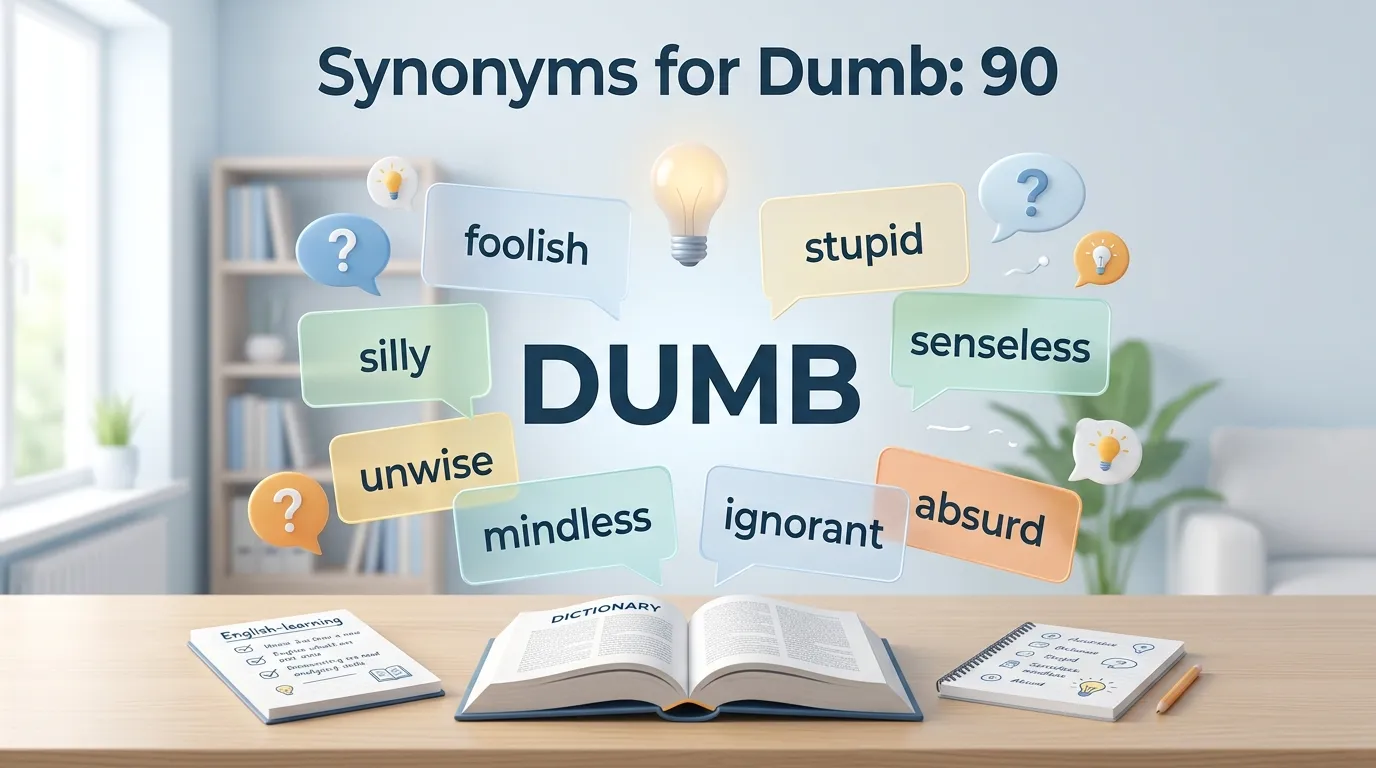
Common synonyms for dumb include silly, foolish, stupid, senseless, unintelligent, clueless, ignorant, and unwise. The best choice depends on your meaning and tone. Some words describe poor decisions, while others describe a lack of knowledge, understanding, or good judgment in a specific situation.
A student writes an answer too quickly and later notices a simple mistake. A friend laughs and says, “That was dumb!” But the speaker may mean the decision was unwise, not that the person lacks intelligence. This small difference matters when choosing better words.
For example, saying “That was careless” can sound kinder than calling someone “stupid.” The right synonym helps you explain your idea without making your sentence sound too harsh.
Students can use these words to make essays more precise.
Bloggers can avoid repeating the same word in every paragraph.
Content writers can choose words that match their audience and tone.
Daily English users can speak more clearly and naturally.
“Words can change the way a simple idea feels.”
Learning synonyms for dumb is not only about finding stronger words. It is about choosing the right word for the right situation.
“Good writing says what you mean with care.”
90 Dumb Synonym
1. Stupid
- Meaning: This describes someone or something that shows very little good sense or thought.
- Examples: That was a stupid choice.
He made a stupid mistake.
2. Foolish
- Meaning: This describes an action that lacks good judgment or sensible thinking.
- Examples: Leaving early was foolish.
That was a foolish decision.
3. Silly
- Meaning: This describes behavior or ideas that seem playful, unreasonable, or lacking serious thought.
- Examples: That sounds like a silly idea.
I made a silly mistake.
4. Unintelligent
- Meaning: This describes someone or something that does not show strong thinking or understanding.
- Examples: The plan seemed unintelligent.
His answer sounded unintelligent.
5. Foolhardy
- Meaning: This describes someone who takes risks without thinking about possible danger.
- Examples: That was a foolhardy move.
His choice seemed completely foolhardy.
6. Senseless
- Meaning: This describes something that has no useful reason, purpose, or sensible meaning.
- Examples: The argument became senseless.
That was a senseless act.
7. Unwise
- Meaning: This describes a choice that does not show good judgment or careful thinking.
- Examples: Borrowing money was unwise.
That seems like an unwise choice.
8. Clueless
- Meaning: This describes someone who does not understand what is happening or what to do.
- Examples: I was clueless about the rules.
He looked completely clueless.
9. Ignorant
- Meaning: This describes someone who lacks knowledge about a particular subject or matter.
- Examples: She was ignorant of the rules.
He seemed ignorant about taxes.
10. Thoughtless
- Meaning: This describes someone who acts without considering other people or possible results.
- Examples: That comment was thoughtless.
His message sounded thoughtless.
11. Careless
- Meaning: This describes someone who does not give enough attention to avoid mistakes.
- Examples: I was careless with details.
Her careless work caused problems.
12. Mindless
- Meaning: This describes an action done without careful thought, attention, or purpose.
- Examples: It was a mindless mistake.
He made a mindless choice.
13. Inane
- Meaning: This describes words or ideas that seem silly, empty, or without useful meaning.
- Examples: His comment sounded inane.
They asked an inane question.
14. Absurd
- Meaning: This describes something that seems extremely unreasonable, strange, or impossible to accept.
- Examples: That idea sounds absurd.
His excuse was completely absurd.
15. Ridiculous
- Meaning: This describes something so unreasonable or silly that it may deserve laughter.
- Examples: That rule is ridiculous.
His excuse sounded ridiculous.
16. Nonsensical
- Meaning: This describes an idea or statement that does not make clear sense.
- Examples: His answer was nonsensical.
The story became nonsensical quickly.
17. Unreasonable
- Meaning: This describes a choice or idea that does not seem fair, sensible, or logical.
- Examples: That request seems unreasonable.
His demand was unreasonable.
18. Illogical
- Meaning: This describes thinking that does not follow a clear or sensible line of reasoning.
- Examples: Her argument was illogical.
That conclusion seems illogical.
19. Irrational
- Meaning: This describes behavior or thinking that does not follow reason or careful judgment.
- Examples: His fear seemed irrational.
That reaction was irrational.
20. Imprudent
- Meaning: This describes an action that shows poor judgment about possible problems.
- Examples: The purchase was imprudent.
His decision seemed imprudent.
21. Inconsiderate
- Meaning: This describes behavior that fails to think about another person’s feelings or needs.
- Examples: That message was inconsiderate.
His behavior seemed inconsiderate.
22. Naive
- Meaning: This describes someone who lacks experience and trusts things too easily.
- Examples: I was naive about business.
Her answer showed a naive view.
23. Unthinking
- Meaning: This describes something done quickly without stopping to consider its effect.
- Examples: It was an unthinking remark.
His unthinking action hurt her.
24. Brainless
- Meaning: This informal word describes behavior that seems to show very little thought or sense.
- Examples: That was a brainless decision.
He made a brainless mistake.
25. Thick
- Meaning: This informal word can describe someone seen as slow to understand an idea.
- Examples: He can be thick sometimes.
I was being thick today.
26. Dense
- Meaning: This informal word can describe someone who is slow to understand something obvious.
- Examples: I was dense about the clue.
He seemed dense at first.
27. Obtuse
- Meaning: This describes someone who is slow to understand an obvious point or idea.
- Examples: His answer seemed obtuse.
She was being obtuse about it.
28. Slow
- Meaning: This informal word can describe someone who takes longer than others to understand something.
- Examples: I was slow to notice.
He is slow with numbers.
29. Simple-minded
- Meaning: This describes thinking that is too basic and does not consider deeper ideas.
- Examples: His view was simple-minded.
That answer sounds simple-minded.
30. Gullible
- Meaning: This describes someone who believes things easily without checking whether they are true.
- Examples: He was too gullible online.
Don’t be so gullible.
31. Foolish-minded
- Meaning: This describes thinking that shows poor judgment or a lack of sensible ideas.
- Examples: His plan was foolish-minded.
That view seems foolish-minded.
32. Unthinking
- Meaning: This describes a person or action that happens without enough thought or care.
- Examples: It was an unthinking choice.
Her reply was unthinking.
33. Ill-advised
- Meaning: This describes an action or decision that was not wise or carefully considered.
- Examples: That trip was ill-advised.
His plan seemed ill-advised.
34. Short-sighted
- Meaning: This describes thinking that focuses on now without considering future results.
- Examples: That plan was short-sighted.
His choice seemed short-sighted.
35. Uncritical
- Meaning: This describes accepting ideas without examining them carefully or asking useful questions.
- Examples: His thinking was uncritical.
She gave an uncritical answer.
36. Unreasoning
- Meaning: This describes behavior that does not use careful thought, logic, or reason.
- Examples: His anger became unreasoning.
That response seemed unreasoning.
37. Uninformed
- Meaning: This describes someone who does not have enough information about a subject.
- Examples: His opinion was uninformed.
I was uninformed about taxes.
38. Uneducated
- Meaning: This describes someone who has had limited education or lacks knowledge in an area.
- Examples: His comment sounded uneducated.
The claim was poorly informed.
39. Inexperienced
- Meaning: This describes someone who lacks practice or knowledge because they are new to something.
- Examples: I was inexperienced then.
Her choice reflected inexperience.
40. Inexpert
- Meaning: This describes someone who does not yet have enough skill or knowledge.
- Examples: His work was inexpert.
She gave an inexpert opinion.
41. Inept
- Meaning: This describes someone who lacks the skill needed to handle a task well.
- Examples: His handling was inept.
The manager seemed inept.
42. Incompetent
- Meaning: This describes someone who lacks the needed ability to perform a task properly.
- Examples: The worker seemed incompetent.
His management was incompetent.
43. Unskilled
- Meaning: This describes someone who does not yet have enough skill for a particular task.
- Examples: He was unskilled at cooking.
She was unskilled with tools.
44. Unaware
- Meaning: This describes someone who does not know about something happening around them.
- Examples: He was unaware of danger.
She seemed unaware of the problem.
45. Oblivious
- Meaning: This describes someone who does not notice something that others can clearly see.
- Examples: He was oblivious to the noise.
She seemed oblivious to everyone.
46. Unobservant
- Meaning: This describes someone who fails to notice important details in their surroundings.
- Examples: He was unobservant that day.
Her mistake came from being unobservant.
47. Unthinking-minded
- Meaning: This describes someone who acts quickly without carefully considering the situation or results.
- Examples: His choice was unthinking-minded.
That response seemed unthinking-minded.
48. Fool
- Meaning: This noun describes a person who behaves without good sense or judgment.
- Examples: Don’t act like a fool.
He felt like a fool.
49. Nincompoop
- Meaning: This playful informal word describes someone who behaves in a foolish or silly way.
- Examples: I felt like a nincompoop.
Don’t be such a nincompoop.
50. Idiotic
- Meaning: This strong informal word describes an action or idea as extremely foolish or unreasonable.
- Examples: That was an idiotic choice.
His plan sounded idiotic.
How to Choose the Right Synonym for Dumb
Not every synonym for dumb has the same meaning. For a simple mistake, careless, silly, or thoughtless may fit better. If someone lacks information, uninformed, unaware, or ignorant can be more precise.
For poor decisions, words such as unwise, imprudent, ill-advised, and short-sighted explain the problem without directly attacking someone’s intelligence. In casual speech, clueless, dense, or silly may sound more natural.
“The best word is the one that fits the exact idea.”
Dumb Synonyms for Writing and Speaking
In school writing, choose neutral words such as unwise, illogical, uninformed, careless, or unreasonable. They explain the problem more clearly than simply calling something dumb.
In everyday conversation, silly, foolish, clueless, and careless are common choices. Stronger words such as idiotic, stupid, and brainless can sound insulting, so use them carefully. Professional writing usually benefits from describing the exact problem instead of attacking a person.
Are All Synonyms for Dumb Negative?
Most words related to dumb can sound negative, but their strength changes. Silly can be light and playful, while idiotic is much harsher. Uninformed may simply point out missing knowledge, and inexperienced can describe someone who is still learning.
This difference is important. If a person makes one poor choice, calling the decision unwise may be more accurate than labeling the person. Good vocabulary helps you stay clear, fair, and specific.
Synonyms for Dumb in Different Situations
For school or professional writing, use words like illogical, uninformed, unreasonable, unwise, or ill-advised.
For casual conversations, words like silly, foolish, clueless, and careless may fit naturally.
For describing a lack of knowledge, choose ignorant, unaware, uninformed, or inexperienced.
For describing poor judgment, choose foolish, imprudent, short-sighted, or ill-advised.
For playful language, nincompoop can work when the situation is clearly lighthearted.
How Synonyms Improve Your English
Knowing different words for dumb gives you more control over your language. Instead of using one word for every situation, you can explain exactly what went wrong.
For example, clueless means someone does not understand what is happening. Careless points to a lack of attention. Unwise focuses on a poor decision. Illogical points to weak reasoning. Uninformed shows that someone lacks useful information.
This makes your writing clearer and your conversations more natural. It also helps you avoid words that may sound too harsh for the situation.
Conclusion:
Learning synonyms for dumb can make your English more flexible, clear, and natural. Instead of repeating one strong word, you can choose a word that explains the exact problem. Maybe someone made a careless mistake. Maybe an idea was illogical. Maybe a decision was unwise. Or perhaps someone was simply uninformed.
These small differences matter in writing and speaking. Students can use more precise words in essays and assignments. Bloggers and content writers can make their work more varied and interesting. In daily conversations, better word choices can help you express yourself without sounding unnecessarily rude.
Try practicing three or four new words at a time. Write short sentences with them. Use them in emails, schoolwork, social posts, or everyday conversations. Over time, these words will become easier to remember and use.
“Clear words make clear ideas easier to share.”
The goal is not to use the biggest or strongest word. The goal is to use the most accurate word for your meaning, audience, and situation.
“Better vocabulary gives your voice more choices.”

I am Ryan Wilson, a passionate writer at SynonymNexts.com, sharing clear, useful, and engaging content about words, synonyms, and language.