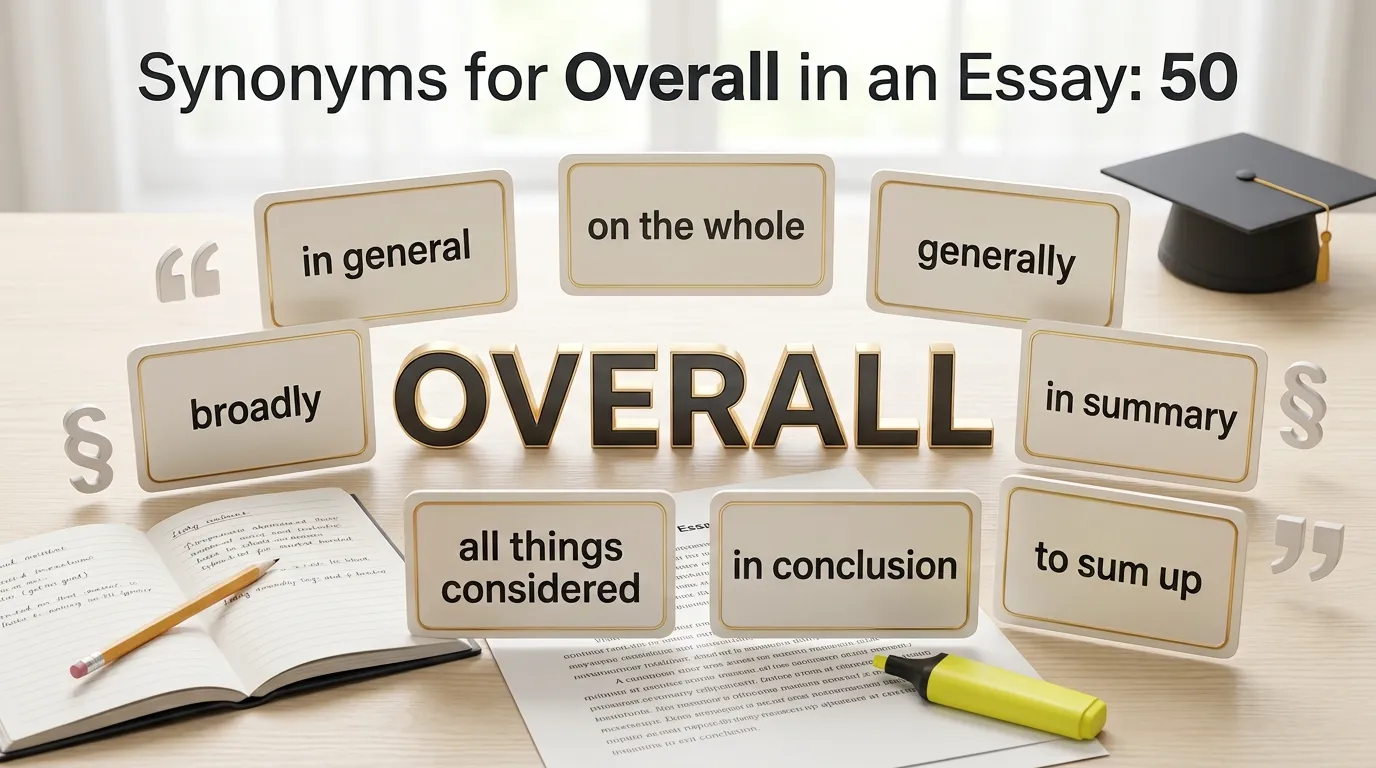
For synonyms for overall in an essay, useful choices include generally, broadly, on the whole, in general, all things considered, and as a whole. These words help you sum up ideas, show the main point, and make academic writing clearer without repeating “overall” too often.
A student finishes an essay and reads the final paragraph. The word “overall” appears three times. It works, but the writing starts to sound repetitive. A few simple alternatives can make the same ideas feel fresher and more natural.
For example, instead of saying, “Overall, the plan was successful,” you could write, “On the whole, the plan was successful.” The meaning stays clear, but the sentence sounds more varied.
Learning different ways to say overall is useful for students who want stronger essays. It helps bloggers avoid repeated words and keeps readers interested. Content writers can use these phrases to give clear summaries. Daily English users can also use them when giving a final opinion.
“Clear writing begins with clear thinking.”
The right phrase also depends on your sentence. Some choices sound formal, while others work well in simple, everyday writing.
“Good words make simple ideas easier to understand.”
50 Synonyms for Overall in an Essay
1. Generally
- Meaning: Generally means something is true in most cases or situations.
- Examples: Generally, the results were quite positive.
Generally, students enjoyed the new lessons.
2. Broadly
- Meaning: Broadly describes something by focusing on its main ideas.
- Examples: Broadly, the plan achieved its goals.
Broadly, the essay supports this view.
3. On the Whole
- Meaning: On the whole means considering everything together before reaching a conclusion.
- Examples: On the whole, the project worked well.
On the whole, students supported the change.
4. In General
- Meaning: In general describes something that is usually true across many situations.
- Examples: In general, people liked the proposal.
In general, the results were encouraging.
5. As a Whole
- Meaning: As a whole considers all parts together instead of focusing on one part.
- Examples: As a whole, the book was useful.
As a whole, the argument remains strong.
6. All Things Considered
- Meaning: All things considered means thinking about every important fact before judging.
- Examples: All things considered, the plan succeeded.
All things considered, the outcome was fair.
7. Taken Together
- Meaning: Taken together means considering several facts or ideas as one complete picture.
- Examples: Taken together, these points support change.
Taken together, the findings seem important.
8. In Summary
- Meaning: In summary introduces a short statement that brings the main ideas together.
- Examples: In summary, the evidence supports recycling.
In summary, the policy had benefits.
9. In Conclusion
- Meaning: In conclusion signals a final statement that brings an essay to an end.
- Examples: In conclusion, education needs more support.
In conclusion, the evidence favors action.
10. To Sum Up
- Meaning: To sum up introduces the main point after discussing several ideas.
- Examples: To sum up, the plan needs changes.
To sum up, both methods can work.
11. Overall
- Meaning: Overall gives a final view after considering the main parts together.
- Examples: Overall, the results were encouraging.
Overall, the project met expectations.
12. Collectively
- Meaning: Collectively means several things are considered together as one group.
- Examples: Collectively, these studies show progress.
Collectively, the ideas create change.
13. Altogether
- Meaning: Altogether means considering all parts together when forming a final view.
- Examples: Altogether, the results were useful.
Altogether, the changes improved learning.
14. In Broad Terms
- Meaning: In broad terms describes the main idea without discussing every small detail.
- Examples: In broad terms, the policy worked.
In broad terms, the argument is convincing.
15. Generally Speaking
- Meaning: Generally speaking introduces an idea that applies to most situations.
- Examples: Generally speaking, students prefer flexibility.
Generally speaking, the system works well.
16. By and Large
- Meaning: By and large means mostly or for the most part.
- Examples: By and large, the plan succeeded.
By and large, readers liked it.
17. For the Most Part
- Meaning: For the most part means something is true in most situations.
- Examples: For the most part, results improved.
For the most part, students agreed.
18. In Most Respects
- Meaning: In most respects means something is true in many important ways.
- Examples: In most respects, the study succeeded.
In most respects, both plans differ.
19. In Large Part
- Meaning: In large part means something happens mainly because of one major factor.
- Examples: In large part, success came from practice.
In large part, growth followed investment.
20. In Broad Outline
- Meaning: In broad outline presents the main structure without focusing on minor details.
- Examples: In broad outline, the argument works.
In broad outline, the process is simple.
21. On Balance
- Meaning: On balance means considering positive and negative points before forming an opinion.
- Examples: On balance, the benefits were greater.
On balance, the plan was useful.
22. Taking Everything Into Account
- Meaning: This phrase means considering all relevant facts before making a final judgment.
- Examples: Taking everything into account, progress was clear.
Taking everything into account, change was needed.
23. Taking Everything Together
- Meaning: This phrase considers all discussed points as one complete set.
- Examples: Taking everything together, results improved.
Taking everything together, the evidence matters.
24. In Overall Terms
- Meaning: In overall terms describes the general result without focusing on small details.
- Examples: In overall terms, costs decreased.
In overall terms, quality improved.
25. In General Terms
- Meaning: In general terms explains an idea without giving every specific detail.
- Examples: In general terms, the plan works.
In general terms, demand increased.
26. Broadly Speaking
- Meaning: Broadly speaking introduces a general idea based on several related facts.
- Examples: Broadly speaking, the system is effective.
Broadly speaking, people welcomed reform.
27. As a General Rule
- Meaning: As a general rule describes something that normally happens in common situations.
- Examples: As a general rule, practice improves skills.
As a general rule, preparation reduces mistakes.
28. In the Main
- Meaning: In the main means mostly or mainly when considering the complete situation.
- Examples: In the main, results were positive.
In the main, students approved.
29. For the Most Part
- Meaning: For the most part shows that something applies to nearly all important cases.
- Examples: For the most part, lessons succeeded.
For the most part, feedback was positive.
30. Mainly
- Meaning: Mainly means mostly and points toward the largest or strongest part.
- Examples: The project was mainly successful.
The essay mainly supports this argument.
31. Mostly
- Meaning: Mostly means true or present in more cases than not.
- Examples: The results were mostly positive.
The responses were mostly supportive.
32. Largely
- Meaning: Largely means mostly and describes the biggest part of something.
- Examples: The project was largely successful.
The outcome was largely expected.
33. Predominantly
- Meaning: Predominantly means mostly and is useful for formal academic writing.
- Examples: The group was predominantly young.
The area was predominantly rural.
34. Chiefly
- Meaning: Chiefly means mainly and identifies the most important part or reason.
- Examples: The problem was chiefly economic.
Success came chiefly through teamwork.
35. Principally
- Meaning: Principally means mainly and works well in formal academic sentences.
- Examples: The policy principally affects workers.
The study principally examines education.
36. Essentially
- Meaning: Essentially focuses on the basic or most important nature of something.
- Examples: Essentially, both plans seek growth.
Essentially, the issue concerns fairness.
37. Fundamentally
- Meaning: Fundamentally describes the basic idea that supports the whole argument.
- Examples: Fundamentally, the issue involves trust.
Fundamentally, both systems share goals.
38. In Essence
- Meaning: In essence summarizes the central idea without including every small detail.
- Examples: In essence, the plan encourages change.
In essence, both views are similar.
39. At Large
- Meaning: At large can describe something considered broadly rather than in one small part.
- Examples: Society at large faces challenges.
The public at large noticed changes.
40. In Total
- Meaning: In total considers the complete amount or result after adding all parts.
- Examples: In total, costs fell sharply.
In total, five areas improved.
41. Taken as a Whole
- Meaning: Taken as a whole means viewing every part together as one complete unit.
- Examples: Taken as a whole, evidence supports reform.
Taken as a whole, the study helps.
42. Viewed Overall
- Meaning: Viewed overall asks readers to consider the complete picture rather than isolated details.
- Examples: Viewed overall, the plan succeeded.
Viewed overall, the results were useful.
43. Considered Together
- Meaning: Considered together means examining related facts at the same time.
- Examples: Considered together, these facts matter.
Considered together, the results show progress.
44. In the Final Analysis
- Meaning: In the final analysis introduces the most important conclusion after careful consideration.
- Examples: In the final analysis, effort matters.
In the final analysis, both methods work.
45. In the Final Assessment
- Meaning: In the final assessment presents a concluding judgment after reviewing the evidence.
- Examples: In the final assessment, risks remained.
In the final assessment, benefits were clear.
46. Looking at the Bigger Picture
- Meaning: This phrase focuses on the complete situation instead of small individual details.
- Examples: Looking at the bigger picture, progress continued.
Looking at the bigger picture, change helped.
47. Considering the Whole
- Meaning: Considering the whole means examining every major part before reaching a conclusion.
- Examples: Considering the whole, results improved.
Considering the whole, the plan worked.
48. From a Broad Perspective
- Meaning: From a broad perspective considers an issue from a wider point of view.
- Examples: From a broad perspective, technology helps.
From a broad perspective, education matters.
49. In Overall Perspective
- Meaning: In overall perspective presents an idea by looking at its complete context.
- Examples: In overall perspective, progress was steady.
In overall perspective, the changes helped.
50. In the Bigger Picture
- Meaning: In the bigger picture focuses on the main meaning of everything together.
- Examples: In the bigger picture, teamwork matters.
In the bigger picture, results improved.
How to Choose the Right Synonym
The best alternative depends on the purpose of your sentence. For a simple essay summary, in general, on the whole, and generally are easy choices. For a more formal academic essay, collectively, predominantly, in the final analysis, and on balance may fit better.
Do not replace overall every time just to avoid repetition. Choose a word that matches your exact meaning. For example, mainly means “mostly,” while on balance suggests that you considered both positive and negative points.
“The best synonym is the one that fits the idea.”
Common Mistakes When Replacing “Overall”
One common mistake is using a synonym without checking its meaning. Words such as mainly, largely, and predominantly usually describe the biggest part, while on the whole gives a broad final view.
Another mistake is using phrases that sound too formal in a simple sentence. Academic writing should still be easy to read. A clear phrase like “In general” can often work better than a complicated expression.
Also, avoid adding a synonym simply because you think every paragraph needs one. Use these words when they help you summarize, connect, or clarify your ideas.
Conclusion:
Knowing different synonyms for overall in an essay can make your writing more natural, clear, and flexible. Instead of using the same word again and again, you can choose a phrase that matches your exact point.
For a simple conclusion, try in general, on the whole, or generally. When you want to bring several facts together, taken together, collectively, or as a whole may work well. If you are weighing different sides, on balance can clearly show that you considered more than one point.
These words are useful beyond essays, too. Bloggers can use them when summarizing an article. Content writers can use them to create smoother transitions. Students can use them in introductions, body paragraphs, and conclusions. They can also help in emails and everyday conversations.
“Strong writing grows through small improvements.”
Try replacing overall in one sentence each day. Read the sentence aloud and check if the new word sounds natural.
“Practice turns new words into useful words.”
With regular practice, you will build a stronger vocabulary and write with greater confidence.

I am Emily Carter, a passionate writer at SynonymNexts.com, creating simple, helpful, and engaging content about synonyms and words.