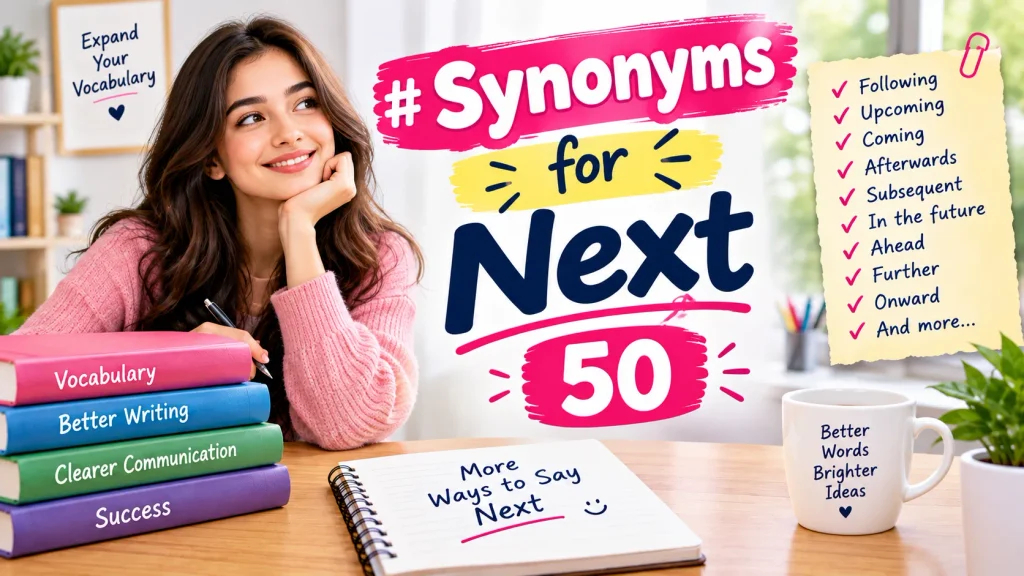
A good synonym for next is following, which means coming right after something in time or order. Other simple words for next are subsequent, upcoming, later, and then. You can choose one based on whether you mean the next event, the next place, or the next step.
Maya stared at her email draft. Three sentences in a row started with “next.” Next, I will call you. Next, we will meet. Next, send the file. It sounded like a robot reading a list, and she knew she needed better words.
“The difference between the almost right word and the right word is really a large matter.” Mark Twain
Here is a simple fix. Instead of “Our next meeting is on Friday,” write “Our upcoming meeting is on Friday.” The idea stays the same, but the sentence feels fresher.
Knowing synonyms for next helps many people. Students write stronger essays. Bloggers keep readers interested. Content writers avoid repeating the same word. Daily English users sound clear and confident. Ready to explore 50 easy options? Let’s begin.
“The limits of my language mean the limits of my world.” Ludwig Wittgenstein
50 Synonyms for Next
1. Following
- Meaning: Coming right after something else in time or in order.
- Examples: Please read the following steps before you begin today. We arrived at the hotel the following morning.
2. Subsequent
- Meaning: Happening later than something else that came before it.
- Examples: Subsequent chapters explain the rules in more detail. She improved in every subsequent test she took.
3. Succeeding
- Meaning: Coming after another person or thing in a clear order.
- Examples: Succeeding generations kept the family recipe alive. He thanked the succeeding speaker after the talk.
4. Upcoming
- Meaning: Going to happen soon, so people are getting ready for it.
- Examples: I am nervous about my upcoming exam. Check the upcoming events on our school page.
5. Coming
- Meaning: About to arrive or happen in the near future.
- Examples: Pack warm clothes for the coming winter trip. The coming week looks very busy for me.
6. Ensuing
- Meaning: Following as a result of something that happened first.
- Examples: The ensuing silence made everyone feel a little nervous. We cleaned up the ensuing mess without any complaint.
7. Later
- Meaning: At a time after now or after another event.
- Examples: I will call you later this evening. Later, we walked home together under the stars.
8. Afterward
- Meaning: At a time after something else has already happened.
- Examples: We ate dinner and watched a movie afterward. Afterward, she wrote a thank-you note to him.
9. Then
- Meaning: Used to show what happens after one thing is done.
- Examples: Wash the rice, then cook it for twenty minutes. First he knocked, and then he opened the door.
10. After
- Meaning: Following in time, so one thing comes behind another.
- Examples: Call me after you finish your homework today. After lunch, the kids played in the garden.
11. Thereafter
- Meaning: From that time on, or right after that moment.
- Examples: He moved abroad and wrote to us weekly thereafter. The shop closed soon thereafter, much to our surprise.
12. Consecutive
- Meaning: Following one after another with no break in between them.
- Examples: Our team won five consecutive games this season. It rained for three consecutive days last week.
13. Successive
- Meaning: Coming one after another in a line or in a series.
- Examples: Successive rules made the game much harder to play. She won three successive prizes at the school fair.
14. Adjacent
- Meaning: Lying right beside something, with nothing placed between the two.
- Examples: Our classroom is adjacent to the school library. He parked in the lot adjacent to the bank.
15. Neighboring
- Meaning: Located very close to a place, often just beside it.
- Examples: A neighboring town hosts the big fair each year. The neighboring shop sells fresh bread every single morning.
16. Adjoining
- Meaning: Sharing a wall or edge with another room or place.
- Examples: Our hotel gave us two adjoining rooms upstairs. The adjoining garden is full of bright yellow flowers.
17. Nearest
- Meaning: Closest to you in distance, so it takes little time.
- Examples: Where is the nearest bus stop to your house? The nearest pharmacy closes at ten tonight.
18. Closest
- Meaning: Having the smallest distance or the smallest gap from something else.
- Examples: He sat in the seat closest to the window. Her closest friend lives just two streets away.
19. Immediate
- Meaning: Coming straight away, with no waiting time before it happens.
- Examples: The doctor needs an immediate answer from you today. Our immediate plan is to finish the report.
20. Forthcoming
- Meaning: Going to appear or happen soon in the near future.
- Examples: Her forthcoming book will be out in the spring. Details of the forthcoming meeting will arrive by email.
21. Impending
- Meaning: About to happen soon, often with a feeling of worry.
- Examples: The impending storm made everyone head back home. We felt nervous about the impending test results.
22. Approaching
- Meaning: Getting closer in time or distance as each moment passes.
- Examples: The approaching holiday has the whole town excited. An approaching car flashed its lights at us.
23. Proximate
- Meaning: Closest in space, time, or the order of events.
- Examples: The proximate cause of the delay was heavy traffic. Choose the proximate exit to save some time.
24. Beside
- Meaning: At the side of someone or something, very close to it.
- Examples: Please sit beside me during the long movie. The cat slept beside the warm fireplace all night.
25. Alongside
- Meaning: Next to something, or together with it at the same time.
- Examples: He worked alongside his brother for many years. Cars were parked alongside the quiet country road.
26. Subsequently
- Meaning: At a later time, after something else has taken place first.
- Examples: She applied and was subsequently offered the new job. The shop subsequently moved to a bigger building downtown.
27. Hereafter
- Meaning: From this moment forward, or in the time that follows.
- Examples: Hereafter, all reports must be sent before Friday noon. We will call him Sam hereafter in this story.
28. Henceforth
- Meaning: From now on, starting at this exact point in time.
- Examples: Henceforth, the library will open one hour earlier daily. She promised to be on time henceforth, always.
29. Thereupon
- Meaning: Right after that, often as a direct reaction to it.
- Examples: He smiled and thereupon left the room quietly. She heard the news and thereupon began to cry.
30. Second
- Meaning: Coming right after the first one in a list or race.
- Examples: She finished second in the school spelling contest. Add the second spoon of sugar after stirring.
31. Another
- Meaning: One more of the same kind, coming after the first.
- Examples: May I please have another slice of cake? Let us try another way to solve this.
32. Further
- Meaning: More, or extra, coming after what was already done or said.
- Examples: Please wait for further news from the office. He made no further comment about the matter.
33. Additional
- Meaning: Added to what is already there, as an extra thing.
- Examples: We need additional chairs for the guests tonight. Additional details will appear in the next newsletter.
34. Soon
- Meaning: In a short time from now, without a long wait.
- Examples: The bus will arrive here very soon. Soon, the sun will set behind the hills.
35. Shortly
- Meaning: In a very short time, only a moment from now.
- Examples: The show will begin shortly, so please sit down. Shortly after noon, the rain finally stopped falling.
36. Presently
- Meaning: In a little while, or at the present moment.
- Examples: The manager will see you presently, so please wait. Presently, dinner was served on the long wooden table.
37. Eventually
- Meaning: At the end of a long time or a series of steps.
- Examples: Eventually, the puppy learned to sit on command. We eventually found the little cafe on the corner.
38. Next Up
- Meaning: Coming right after the current person, item, or event.
- Examples: Next up, we have a short song from Ali. Next up on the list is washing the dishes.
39. Up Next
- Meaning: Planned to come right after what is happening at this moment.
- Examples: Up next, you will hear today’s weather and sports news. Stay with us, because the quiz is up next.
40. Next-Door
- Meaning: Living or located in the very next house or building.
- Examples: Our next-door neighbor bakes the best cookies in town. She runs a small bakery in the next-door shop.
41. Close By
- Meaning: Not far away, so it is easy to reach.
- Examples: There is a small park close by. I like living close by to my parents.
42. Near
- Meaning: A short distance away in space or in time.
- Examples: The station is near our school gate. We are near the end of the lesson.
43. Sequential
- Meaning: Following in a clear order, one step after another.
- Examples: Please complete the sequential steps in the right order. The files are numbered in sequential order for you.
44. Ahead
- Meaning: In front of you, or coming up in the future.
- Examples: A busy week lies ahead of us all. Look ahead and plan your next move carefully.
45. Later On
- Meaning: At some point after now, but not right away.
- Examples: We can talk about this later on today. Later on, he realized she had been right.
46. In Turn
- Meaning: One after another, each taking a place in the order.
- Examples: The students spoke in turn during the class meeting. She thanked each guest in turn at the door.
47. Down the Line
- Meaning: At some later point in the future, not right now.
- Examples: We may add new features down the line. Down the line, this habit will help you greatly.
48. Next in Line
- Meaning: Waiting for a turn that comes right after the current one.
- Examples: You are next in line at the ticket window. Who is next in line for the manager job?
49. Next To
- Meaning: At the side of something, with nothing between the two.
- Examples: She sat next to me on the long train. The bank is next to the small bookstore.
50. Onward
- Meaning: Moving forward in time, or continuing to the next stage.
- Examples: From Monday onward, classes start at eight o’clock sharp. We marched onward until we reached the quiet village.
“The journey of a thousand miles begins with a single step.” Lao Tzu
Another Word for Next Step
When you write “next step,” you can swap it with follow-up action, subsequent step, or upcoming move. In project updates, following step sounds clear and calm. In a casual chat, try what comes after or what’s up next. Pick the version that matches your reader. A teacher, a boss, and a friend all like different tones, so choose wisely and keep the message short.
Formal Synonyms for Next
Formal writing needs careful word choices. Good formal synonyms for next include subsequent, succeeding, ensuing, forthcoming, and thereafter. Use them in reports, letters, and school essays. For example, write “the subsequent chapter” instead of “the next chapter.” Do not overuse them, though. Too many fancy words can make a sentence feel stiff and hard to read.
Synonyms for Next in an Email
Emails should sound polite and clear. Instead of “Next, please send the file,” try “Following that, please send the file” or “After that, please send the file.” For plans, use upcoming or coming. For tasks, use follow-up. These small changes make your message smoother. They also help your reader scan the email faster and respond with less confusion.
Synonyms for Next in a Sentence
Seeing words inside sentences makes them easier to remember. Here are three quick examples. “We will visit the adjacent town.” “Read the following page.” “She spoke afterward.” Each sentence replaces next with a more exact word. Notice how the meaning stays the same, but the style changes. Try writing three of your own sentences today and compare them.
FAQs:
Is “next” an adjective, adverb, or noun?
Next can be all three. As an adjective, it describes a noun, like “the next day.” As an adverb, it tells when something happens, like “What should we do next?” Many dictionaries also list it as a noun or pronoun, meaning the person or thing that comes after. Context decides the role, and synonyms such as following and afterward follow the same pattern.
What is the opposite of “next”?
The opposite of next is usually previous, last, earlier, or preceding. If next means coming after, these words mean coming before. For example, “the next page” becomes “the previous page.” In time, former and prior also work well. Knowing opposites helps you build stronger sentences and avoids confusion when you explain steps or dates.
What is the difference between “next” and “following”?
Next usually means the one that comes right after, with nothing in between. Following is more formal and can point to something that comes after in a list or in time, even if more items follow. For example, “the next day” feels natural in talk, while “the following day” suits reports. Both are correct, so match the tone.
Can I start a sentence with “next”?
Yes, you can. Next works well as a transition word when you describe steps or events, such as “Next, add the eggs.” Put a comma after it in most cases. In formal writing, you may prefer then, afterward, or subsequently. Just avoid starting every sentence with the same word, because it can make the writing feel repetitive and dull.
Conclusion:
Learning synonyms is one of the easiest ways to grow as a writer. When you know many words for next, your writing becomes clearer, smoother, and more interesting. A rich vocabulary also saves time, because you stop searching for the right word. It helps in emails, essays, and speeches.
Bloggers keep readers longer. Students impress teachers. Speakers sound confident. Everyone understands you faster, and that is the real goal of communication.
“Words are, of course, the most powerful drug used by mankiend.” Rudyard Kipling
Do not try to memorize all 50 words at once. Pick five that feel useful today. Use upcoming in an email. Use subsequent in an essay. Use afterward when you tell a story to a friend. Small practice every day builds a strong vocabulary over time.
Save this list, share it with a classmate or teammate, and come back whenever your writing feels repetitive.
“Language is the road map of a culture.” Rita Mae Brown
You now have the tools. Your next sentence is waiting, so go and write it with confidence!

I am Emily Carter, a passionate writer at SynonymNexts.com, creating simple, helpful, and engaging content about synonyms and words.