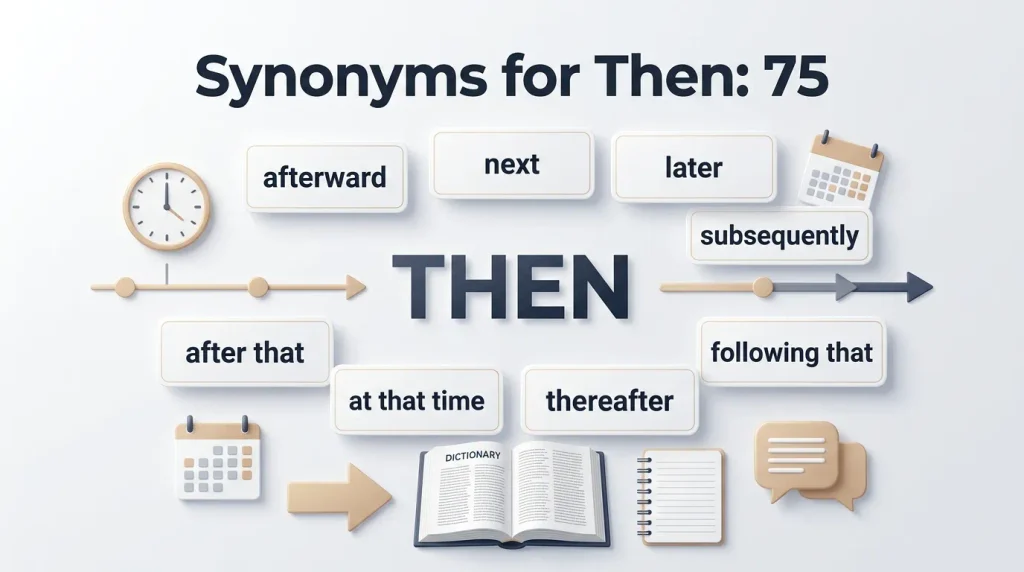
Common synonyms for “then” include afterward, next, later, at that time, following that, subsequently, and in that case. The best choice depends on whether “then” shows time, order, result, or a condition. Using the right alternative can make your writing clearer, smoother, and more natural.
The teacher finished the lesson and closed her book. Then, she asked the students to write one short sentence. A small word helped connect two simple actions. This happens all the time when we speak and write.
For example, you may say, “I finished my homework, then I watched TV.” You can also replace then with another word when you want your sentence to sound less repetitive or more formal.
Students can use these words to make essays and answers flow better.
Bloggers can use them to create smooth steps and easy-to-follow ideas.
Content writers can use them to improve transitions between points.
Daily English users can choose a better word for each situation.
“Clear words make simple ideas easier to understand.”
Learning alternatives does not mean avoiding the word then. It means knowing when another word fits better. Some choices show time, while others show order or a result.
“Good writing often depends on small choices.”
75 Synonyms for Then
1. Afterward
Meaning: Afterward means something happens later, following an earlier event or action.
Examples: We ate dinner afterward.
She called me afterward.
2. Afterwards
Meaning: Afterwards means at a later time after something else has happened.
Examples: We went home afterwards.
He felt better afterwards.
3. Later
Meaning: Later means something happens at a time after the current or earlier moment.
Examples: I will call you later.
She arrived later.
4. Next
Meaning: Next shows that something happens immediately after another event, step, or action.
Examples: Next, open the small box.
We went next to the park.
5. Subsequently
Meaning: Subsequently means something happens after an earlier event, usually in formal writing.
Examples: The plan subsequently changed.
He subsequently moved abroad.
6. Following That
Meaning: Following that shows an action or event happens directly after something mentioned before.
Examples: Following that, we left.
She rested following that.
7. After That
Meaning: After that means something happens later than the event just mentioned.
Examples: We talked after that.
I slept after that.
8. At That Time
Meaning: At that time refers to a particular moment or period mentioned earlier.
Examples: I lived there at that time.
She worked there at that time.
9. At the Time
Meaning: At the time refers to the period when a particular event happened.
Examples: I was young at the time.
He felt nervous at the time.
10. From Then On
Meaning: From then on describes everything that happens continuously after a certain point.
Examples: From then on, we stayed close.
She smiled from then on.
11. From That Point
Meaning: From that point shows that something starts happening after a specific moment.
Examples: From that point, things improved.
He worked harder from that point.
12. From That Moment
Meaning: From that moment means something begins or continues after a particular moment.
Examples: From that moment, she trusted him.
We changed from that moment.
13. Thereafter
Meaning: Thereafter means after that event or time and is mostly used in formal writing.
Examples: Thereafter, the rules changed.
He lived quietly thereafter.
14. Soon After
Meaning: Soon after means something happens shortly after another event or action.
Examples: She called soon after.
We left soon after.
15. Shortly After
Meaning: Shortly after means an event happens a short time after another event.
Examples: He arrived shortly after.
The meeting ended shortly after.
16. Before Long
Meaning: Before long means something happens soon after the present or another event.
Examples: Before long, everyone laughed.
She returned before long.
17. In Time
Meaning: In time can show that something happens later but before a required moment.
Examples: We arrived in time.
He finished in time.
18. Eventually
Meaning: Eventually means something happens after some time, delay, or several earlier events.
Examples: She eventually found work.
They eventually agreed.
19. Ultimately
Meaning: Ultimately means something happens as the final result after other events or choices.
Examples: They ultimately chose peace.
He ultimately accepted the offer.
20. Finally
Meaning: Finally shows that something happens at the end of a process or series.
Examples: Finally, we reached home.
She finally understood the lesson.
21. In the End
Meaning: In the end shows the final result after events, choices, or difficulties.
Examples: In the end, we won.
He stayed in the end.
22. At Last
Meaning: At last shows that something happens after waiting, delay, or difficulty.
Examples: At last, the bus came.
She smiled at last.
23. Afterwards, That
Meaning: This phrase can connect a later action with something already mentioned in casual speech.
Examples: We ate, afterwards that felt easy.
He rested afterwards, that helped.
24. Later On
Meaning: Later on means at a later point, often without giving an exact time.
Examples: We talked later on.
She changed her mind later on.
25. Awhile Later
Meaning: Awhile later means something happens after a short or unspecified period of time.
Examples: Awhile later, he returned.
She called awhile later.
26. At a Later Time
Meaning: At a later time means something will happen after the present or earlier event.
Examples: We can discuss it at a later time.
He replied at a later time.
27. In Due Course
Meaning: In due course means something happens at the proper or expected time later.
Examples: You will know in due course.
The answer came in due course.
28. In Sequence
Meaning: In sequence shows that events or actions happen in their proper order.
Examples: Read the steps in sequence.
The events happened in sequence.
29. In Order
Meaning: In order shows that things happen or appear according to a planned sequence.
Examples: Complete each task in order.
The pages appear in order.
30. Afterward in the Process
Meaning: This phrase points to an action that occurs later during a continuing process.
Examples: We checked the work afterward in the process.
She fixed errors afterward in the process.
31. Following This
Meaning: Following this means something happens directly after an action, idea, or event.
Examples: Following this, we started work.
Following this, she left.
32. Following That Event
Meaning: Following that event shows that another action happens after a specific event.
Examples: Following that event, plans changed.
The team met following that event.
33. After This
Meaning: After this means something will happen later than the current action or event.
Examples: We will talk after this.
She left after this.
34. Afterward, in Turn
Meaning: This expression can show that an action happens later as part of a sequence.
Examples: Each guest spoke afterward, in turn.
The team responded afterward, in turn.
35. In the Following Moment
Meaning: This phrase points to something happening immediately or very soon after an earlier moment.
Examples: He laughed in the following moment.
She answered in the following moment.
36. In the Following Step
Meaning: This phrase shows that an action comes after another step in a process.
Examples: Add water in the following step.
We checked results in the following step.
37. At That Point
Meaning: At that point refers to a specific stage or moment reached during events.
Examples: At that point, we stopped.
She agreed at that point.
38. At That Stage
Meaning: At that stage refers to a particular part of a process or situation.
Examples: At that stage, we waited.
He was ready at that stage.
39. Once That Happened
Meaning: Once that happened shows that another action followed a completed earlier event.
Examples: Once that happened, we left.
She relaxed once that happened.
40. When That Happened
Meaning: When that happened connects another event to the time when something occurred.
Examples: When that happened, everyone stopped.
He called when that happened.
41. In That Case
Meaning: In that case means if the situation just mentioned is true, another action follows.
Examples: In that case, we can stay.
She agreed in that case.
42. If So
Meaning: If so means if the statement or situation just mentioned is correct.
Examples: If so, we should leave.
If so, call me.
43. If That Happens
Meaning: If that happens introduces an action or result connected to a possible future situation.
Examples: If that happens, call me.
We will help if that happens.
44. In That Situation
Meaning: In that situation refers to what should happen under the stated circumstances.
Examples: In that situation, stay calm.
I would wait in that situation.
45. Under Those Circumstances
Meaning: Under those circumstances describes what happens because of a particular situation or condition.
Examples: Under those circumstances, we left.
He agreed under those circumstances.
46. Consequently
Meaning: Consequently means something happens as a result of an earlier action or event.
Examples: It rained; consequently, we stayed inside.
He worked hard; consequently, he improved.
“The right transition helps each idea lead naturally to the next.”
47. Therefore
Meaning: Therefore shows that one idea or action is the result of another.
Examples: It was late; therefore, we left.
She studied; therefore, she passed.
48. As a Result
Meaning: As a result shows that something happens because of an earlier action or event.
Examples: He practiced; as a result, he improved.
It snowed; as a result, school closed.
49. Hence
Meaning: Hence means for this reason or as a result, especially in formal writing.
Examples: The road closed; hence, we waited.
He was sick; hence, he stayed.
50. Thus
Meaning: Thus means in this way or as a result of something previously stated.
Examples: She practiced daily; thus, she improved.
The plan failed; thus, we changed it.
How to Choose the Right Synonym for Then
The best synonym depends on what then means in your sentence. If you are talking about time, words such as later, afterward, subsequently, and after that can work well. If you are showing order, next or following this may sound more natural.
When then introduces a condition, in that case or if so can be better. When it shows a result, therefore, consequently, thus, or as a result may fit.
This small difference matters. Replacing every use of then with the same word can make your writing sound unnatural. Always look at the meaning first.
Then in Everyday English
The word then is very common in everyday conversations. We often use it to connect two actions: “I finished work, then I went home.” In casual speech, later, next, afterward, and after that are useful alternatives.
You do not need a difficult word every time. Simple words often sound more natural in messages, conversations, and personal writing. Use formal alternatives such as subsequently, thereafter, hence, and thus when the style calls for them.
Then in Academic and Professional Writing
Academic and professional writing often needs clear transitions. Instead of repeating then, writers can use subsequently, thereafter, following this, consequently, or therefore, depending on the intended meaning.
For example, “The company changed its policy. Subsequently, customer complaints decreased” sounds more formal than repeating “then.” Still, clarity should come first. A simple word is often better than a complex one when both have the same meaning.
Then for Time, Order, and Results
One reason then can be confusing is that it has several uses. It can show time, as in “I was younger then.” It can show order, as in “First we walked, then we ate.” It can also show a condition, as in “If you are ready, then we can leave.”
It can even introduce a result. In that situation, alternatives such as therefore or as a result may be more accurate. Understanding the sentence purpose helps you select the right synonym instead of choosing a word randomly.
FAQs:
What is the easiest synonym for then?
The easiest alternatives to then are usually later, next, afterward, and after that. These words are common and easy to understand. Use next when you are showing the following step, later when something happens after now, and afterward when an action follows another event. For everyday conversations and simple writing, these choices are often more natural than formal words such as subsequently or thereafter.
Is “then” formal or informal?
Then can be used in both formal and informal English. It is a normal everyday word, so you can use it in conversations, emails, essays, and professional writing. However, some sentences may sound more precise with words such as subsequently, thereafter, consequently, or therefore. The best choice depends on the meaning and tone of your sentence, not simply on whether the writing is formal.
Can “then” and “than” mean the same thing?
No. Then and than have different meanings and should not be treated as synonyms. Then usually relates to time, order, or a result. Than is mainly used when comparing two things, such as “She is taller than me.” A useful memory trick is that then often connects events, while than commonly appears in comparisons.
How can I avoid repeating “then” in writing?
First, identify what then means in each sentence. If it shows order, try next or following this. If it shows later time, use afterward or later. If it introduces a result, consider therefore, consequently, or as a result. You can also remove the transition when the sentence remains clear. Good writing does not require replacing every repeated word.
Conclusion:
Learning synonyms for then can make your English more flexible and your writing easier to follow. The word then is useful, but repeating it too often may make a paragraph feel flat. Knowing alternatives gives you more ways to connect ideas.
For time, you can use words such as later, afterward, subsequently, and after that. For order, next and following this can work well. For results, therefore, consequently, thus, and as a result may be better choices. For conditions, phrases like in that case and if so can make your meaning clearer.
Students can use these words in essays and school assignments. Bloggers and content writers can use them to create smoother paragraphs. In emails and daily conversations, simple choices such as later, next, and afterward often sound natural.
“Every new word gives you another way to express an idea.”
The best way to learn is to practice. Write a few sentences today using different alternatives for then. Try them in emails, essays, stories, and everyday conversations. With regular practice, choosing the right word will become easier.
“Better vocabulary grows through small, repeated practice.”

I am Emily Carter, a passionate writer at SynonymNexts.com, creating simple, helpful, and engaging content about synonyms and words.