A useful synonym for “synonyms for complete” is “entire,” “finished,” or “whole.” These words can show that something has all its parts or that an action has ended. The best choice depends on whether you mean something is finished, full, whole, or fully done.
The final page of a school project is ready. A writer checks every section, adds the last detail, and smiles. The work is now complete. But using the same word again and again can make writing feel flat.
For example, instead of saying, “The report is complete,” you could say, “The report is finished.” In another sentence, “The complete story” could become “the whole story.” Small word changes can make your writing clearer and more natural.
Students can use synonyms to make essays stronger. Bloggers can avoid repeating the same words. Content writers can create smoother articles. Daily English users can choose words that fit each situation.
Learning alternatives for complete also helps you understand the different meanings of the word. Sometimes it means finished. Sometimes it means whole, full, or lacking nothing.
“Words are tools, and the right tool makes the job easier.”
A good vocabulary gives you more ways to explain simple ideas without making your writing difficult.
“Clear writing begins with clear word choices.”
65 Complete Synonym
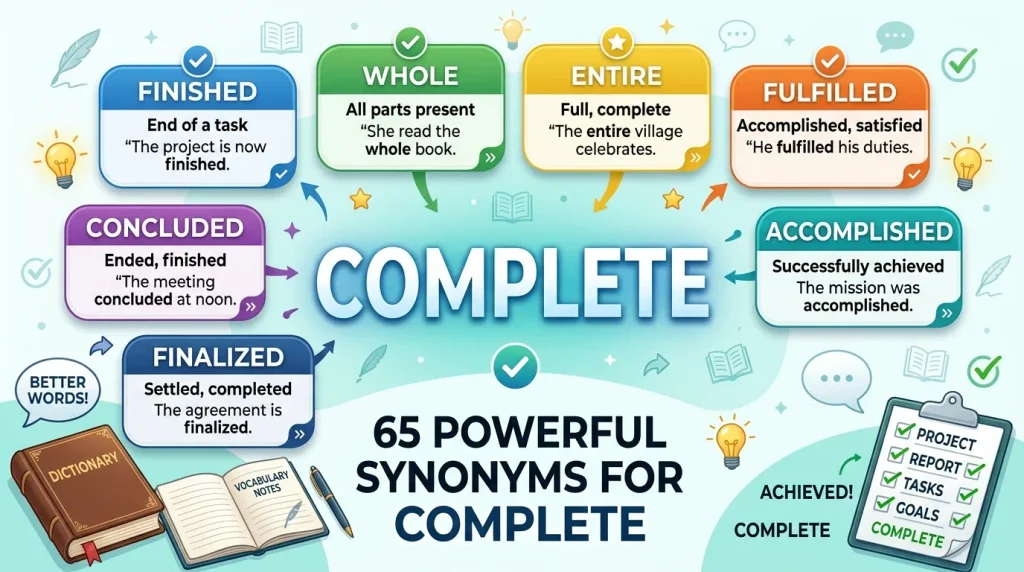
1. Entire
- Meaning: Entire means having all parts of something together as one whole.
- Examples: I read the entire book. She spent the entire day studying.
2. Whole
- Meaning: Whole means having every part with nothing missing or removed.
- Examples: He ate the whole cake. We watched the whole movie.
3. Finished
- Meaning: Finished means something has reached its end and needs no more work.
- Examples: My homework is finished now. She finished the report yesterday.
4. Concluded
- Meaning: Concluded means an activity, event, or process has reached its ending point.
- Examples: The meeting concluded at noon. The lesson concluded with questions.
5. Accomplished
- Meaning: Accomplished means successfully finished a task, goal, or important piece of work.
- Examples: She accomplished her main goal. We accomplished everything before lunch.
6. Fulfilled
- Meaning: Fulfilled means a duty, promise, need, or goal has been successfully completed.
- Examples: He fulfilled his promise today. She fulfilled all course requirements.
7. Finalized
- Meaning: Finalized means something has been completed and is ready for use.
- Examples: The plan is finalized now. We finalized the contract yesterday.
8. Done
- Meaning: Done means an action or task has been fully completed.
- Examples: My work is done. Dinner will be done soon.
9. Perfected
- Meaning: Perfected means improved something until it reached a very high standard.
- Examples: She perfected her recipe. He perfected the design carefully.
10. Thorough
- Meaning: Thorough means including careful attention to every important part or detail.
- Examples: She gave a thorough review. We need a thorough check.
11. Comprehensive
- Meaning: Comprehensive means covering many details, parts, or areas of something.
- Examples: The guide is comprehensive and clear. He wrote a comprehensive report.
12. Exhaustive
- Meaning: Exhaustive means covering every possible part, detail, or choice.
- Examples: They made an exhaustive search. The study gives exhaustive details.
13. Total
- Meaning: Total means including everything or the full amount of something.
- Examples: The total cost was low. We need total agreement first.
14. Full
- Meaning: Full means containing all that is needed or expected.
- Examples: The form is full. She gave a full answer.
15. Finished-off
- Meaning: Finished-off describes something brought to its final stage or ending.
- Examples: He finished off the project. She finished off the last section.
16. Final
- Meaning: Final means being at the last stage with no further changes expected.
- Examples: This is the final version. We made the final choice.
17. Accomplished
- Meaning: Accomplished can describe something successfully brought to its intended end.
- Examples: The task was accomplished quickly. Their mission was accomplished successfully.
18. Achieved
- Meaning: Achieved means successfully reached a goal, result, or desired point.
- Examples: She achieved her target. We achieved excellent results.
19. Realized
- Meaning: Realized means successfully made a plan, goal, or idea happen.
- Examples: He realized his dream. The team realized its plan.
20. Completed
- Meaning: Completed means finished all required parts of a task or activity.
- Examples: I completed the assignment. She completed the training course.
21. Executed
- Meaning: Executed means carried out a planned task or action successfully.
- Examples: They executed the plan well. She executed every step carefully.
22. Fulfilled
- Meaning: Fulfilled means meeting all conditions needed for a duty, wish, or requirement.
- Examples: He fulfilled the job requirements. She fulfilled her childhood dream.
23. Satisfied
- Meaning: Satisfied means meeting a need, condition, demand, or required standard.
- Examples: The answer satisfied the question. The product satisfied our needs.
24. Closed
- Meaning: Closed means bringing a process, matter, or activity to an ending.
- Examples: The case is closed. We closed the project yesterday.
25. Settled
- Meaning: Settled means a matter has been resolved and needs no further action.
- Examples: The issue is settled. Their payment was settled today.
26. Resolved
- Meaning: Resolved means a problem or question has been successfully dealt with.
- Examples: The problem is resolved. She resolved the issue quickly.
27. Finished
- Meaning: Finished means something has reached the point where no more work remains.
- Examples: The painting is finished. We finished the work early.
28. Wholehearted
- Meaning: Wholehearted means giving complete effort, support, or feeling without holding anything back.
- Examples: She gave wholehearted support. He offered wholehearted help.
29. Absolute
- Meaning: Absolute means complete, certain, or not limited by anything.
- Examples: We need absolute trust. She showed absolute confidence.
30. Utter
- Meaning: Utter means complete or total, often used to strongly describe a condition.
- Examples: His answer was utter nonsense. The room fell into utter silence.
31. Unabridged
- Meaning: Unabridged means containing the full original content without parts being shortened.
- Examples: I bought the unabridged book. She prefers unabridged stories.
32. Undivided
- Meaning: Undivided means whole and not separated, shared, or divided into parts.
- Examples: He gave undivided attention. She enjoyed his undivided support.
33. Integral
- Meaning: Integral means necessary and included as an important part of something.
- Examples: Trust is integral to friendship. Practice is integral to learning.
34. Inclusive
- Meaning: Inclusive means covering all people, parts, items, or important possibilities.
- Examples: The price is inclusive of tax. The plan is inclusive and fair.
35. Full-scale
- Meaning: Full-scale means complete in size, scope, effort, or level.
- Examples: They began a full-scale study. The company launched a full-scale campaign.
36. All-inclusive
- Meaning: All-inclusive means covering everything needed within one complete package or arrangement.
- Examples: We booked an all-inclusive trip. The package is all-inclusive.
37. Finished up
- Meaning: Finished up means completed the last remaining part of an activity.
- Examples: I finished up my work. She finished up before dinner.
38. Wrapped up
- Meaning: Wrapped up means brought an activity, task, or event to an end.
- Examples: We wrapped up the meeting. He wrapped up his project.
39. Brought to an end
- Meaning: This phrase means something has been fully completed or stopped.
- Examples: They brought the project to an end. She brought the discussion to an end.
40. Brought to completion
- Meaning: This phrase means a task or project has reached its completed state.
- Examples: The work was brought to completion. They brought the plan to completion.
41. Exhausted
- Meaning: Exhausted can mean using or covering all available parts, choices, or resources.
- Examples: We exhausted every option. The search exhausted all possibilities.
42. Filled
- Meaning: Filled means containing as much as needed or having no empty space.
- Examples: The form is filled. The room was filled with guests.
43. Perfect
- Meaning: Perfect means complete or without mistakes, faults, or missing parts.
- Examples: Your answer is perfect. The timing was perfect today.
44. Finished completely
- Meaning: Finished completely means every required part has been done without anything remaining.
- Examples: The work is finished completely. She cleaned the room completely.
45. Matured
- Meaning: Matured can describe something that has developed fully or reached its proper stage.
- Examples: The plan has matured. Their idea matured over time.
46. Developed
- Meaning: Developed means something has grown or progressed to a fuller state.
- Examples: She developed the idea further. The project is fully developed.
47. Established
- Meaning: Established means something has been fully set up, accepted, or made firm.
- Examples: The system is established now. They established a complete process.
48. Finalized
- Meaning: Finalized means all important decisions or changes have been completed.
- Examples: The schedule is finalized. We finalized our plans today.
49. Perfected
- Meaning: Perfected means completed with careful improvements until no major changes are needed.
- Examples: He perfected his speech. She perfected the final design.
50. Whole and finished
- Meaning: Whole and finished describes something that has every part and needs no more work.
- Examples: The project is whole and finished. Our work is whole and finished.
How to Choose the Right Synonym for Complete
Not every synonym for complete works in every sentence. If you mean that a task has ended, words such as finished, done, concluded, and completed are natural choices.
If you mean that something contains every part, try entire, whole, full, or comprehensive. For formal writing, comprehensive, exhaustive, finalized, and fulfilled can work well. In casual speech, done, finished, and wrapped up sound more natural.
A useful trick is to ask what you really mean before replacing the word. Is something finished? Is it whole? Does it include everything? Once you know the meaning, the right synonym becomes easier to choose.
“The strongest word is often the simplest word that fits.”
Complete Synonyms for Writing
When writing essays, articles, emails, or reports, synonyms can help prevent repeated wording. Instead of using complete several times, you can choose finished, whole, comprehensive, or finalized, depending on the sentence.
For example, “The complete report is ready” can become “The final report is ready.” “She gave a complete explanation” could become “She gave a thorough explanation.” These changes keep your writing natural without making it harder to understand.
Complete Synonyms for Daily English
Daily conversations usually need simple words. Done, finished, whole, full, and final are easy choices.
You might say, “I’m done with my homework,” or “We watched the whole show.” In a workplace, you may hear “The project is complete,” “The plan is finalized,” or “The meeting has concluded.” Choosing the right word depends on the setting and the meaning you want.
Complete Synonyms for Formal Writing
Formal writing often needs more precise vocabulary. Words such as comprehensive, exhaustive, fulfilled, finalized, concluded, and accomplished can make a sentence more exact.
However, a difficult word is not always a better word. If finished explains your meaning clearly, there is no need to replace it with a complex term. Good writing is clear first. Strong vocabulary should help readers, not confuse them.
FAQs:
What is another word for complete?
Another word for complete is finished when you mean that a task has ended. Other choices include whole, entire, full, completed, finalized, comprehensive, and thorough. The best option depends on your sentence. For example, “The project is finished” means the work has ended, while “the entire project” means every part of the project is included.
What is a simple synonym for complete?
A simple synonym for complete is done or finished. These words are easy to understand and common in everyday English. For example, “My homework is complete” can become “My homework is done.” In writing, whole and full are also simple choices when you are talking about something that contains all its parts.
What is the opposite of complete?
The opposite of complete depends on the meaning. If complete means finished, the opposite can be unfinished, incomplete, or pending. If it means having every part, the opposite can be partial, missing, or incomplete. For example, “The report is incomplete” means some parts still need to be added or changed.
Is complete a formal word?
Yes, complete can be used in both formal and casual English. It is a common and flexible word that works well in school writing, business communication, articles, and daily conversations. In formal writing, more specific words such as comprehensive, finalized, or concluded may sometimes give a clearer meaning, but complete is still perfectly suitable.
Conclusion:
Learning synonyms for complete gives you more ways to express simple ideas. You can say that work is finished, a story is whole, a report is comprehensive, or a plan is finalized. Each word gives your sentence a slightly different meaning.
For students, these words can make essays and assignments less repetitive. For bloggers, they can create smoother articles and better word variety. Content writers can use them to make sentences more precise. In daily communication, the right word can make a message easier to understand.
The key is not to use a synonym just because it sounds advanced. First, think about the meaning you need. Then choose the word that fits your sentence naturally.
Try practicing these words in your own writing. Replace repeated words in an email, use a new synonym in an essay, or add one to a daily conversation. Even a small vocabulary change can make your English stronger.
“Practice turns new words into natural words.”
The more often you use these alternatives, the easier they will become to remember. Soon, you will have many clear ways to describe something that is complete, finished, whole, or fully done.
“Good vocabulary gives simple ideas more ways to shine.”

I am Lily Peterson, a passionate writer at SynonymNexts.com, creating clear, helpful, and engaging content about synonyms, words, and language.