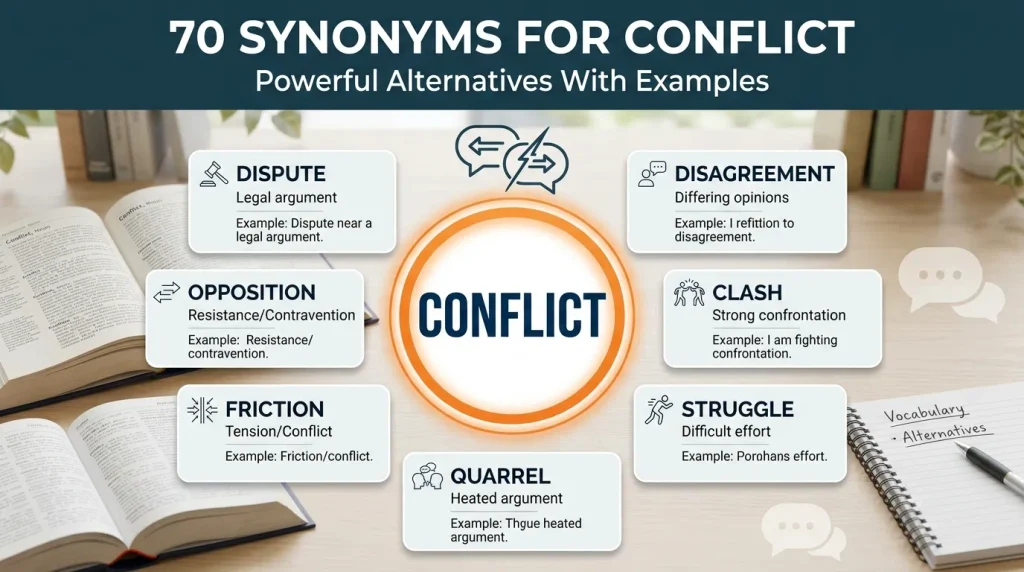
Common synonyms for conflict include disagreement, dispute, argument, clash, struggle, quarrel, friction, tension, confrontation, and opposition. These words can describe problems between people, groups, ideas, or goals. The best synonym depends on the situation, such as a small argument, a serious fight, or a clash between different views.
The meeting was going well until two team members disagreed about the project plan. Their voices became louder, and the room grew quiet. No one wanted a big problem, but the discussion had turned into a conflict.
This happens in school, at work, online, and even at home. Knowing different words for conflict can help you explain these moments more clearly. For example, you might call a small problem a disagreement, while a stronger problem may be a clash or confrontation.
Students can use these words to make essays more interesting. Bloggers can avoid repeating the same word in every paragraph. Content writers can choose words that match the exact situation. Daily English users can speak and write with more confidence.
“Clear words make difficult ideas easier to understand.”
Learning several alternatives also helps you notice small differences in tone. Some words sound gentle, while others suggest serious trouble.
“The right word can change the way a message feels.”
70 Conflict Synonym
1. Disagreement
- Meaning: A disagreement happens when people have different views or opinions.
- Examples: We had a disagreement about lunch.
They solved the disagreement before class.
2. Dispute
- Meaning: A dispute is a serious disagreement about something important.
- Examples: The neighbors had a dispute.
They discussed the dispute calmly together.
3. Argument
- Meaning: An argument happens when people speak strongly about different opinions.
- Examples: They had an argument yesterday.
The argument ended after dinner.
4. Clash
- Meaning: A clash happens when people or ideas strongly oppose each other.
- Examples: Their views often clash at meetings.
The two teams clashed during practice.
5. Struggle
- Meaning: A struggle is a difficult fight against a problem or person.
- Examples: She faced a personal struggle.
They struggle to agree on plans.
6. Quarrel
- Meaning: A quarrel is an angry argument between people who disagree.
- Examples: The brothers had a quarrel.
Their quarrel ended quickly afterward.
7. Fight
- Meaning: A fight can mean a physical or strong verbal conflict.
- Examples: The friends had a fight.
They stopped fighting before bedtime.
8. Confrontation
- Meaning: A confrontation is a direct meeting caused by serious disagreement.
- Examples: The meeting became a confrontation.
He avoided a direct confrontation.
9. Friction
- Meaning: Friction means ongoing tension that makes relationships or teamwork difficult.
- Examples: There is friction between them.
Workplace friction slowed the project.
10. Tension
- Meaning: Tension is a feeling of stress caused by disagreement or trouble.
- Examples: Tension filled the room.
The team felt tension all morning.
11. Opposition
- Meaning: Opposition means strong disagreement with a person, idea, or plan.
- Examples: The plan faced strong opposition.
She spoke in opposition to it.
12. Hostility
- Meaning: Hostility means unfriendly or angry feelings toward someone.
- Examples: His words showed hostility.
They tried to reduce hostility.
13. Feud
- Meaning: A feud is a long and angry conflict between people or groups.
- Examples: The families ended their feud.
Their feud lasted for years.
14. Rivalry
- Meaning: Rivalry is competition between people or groups trying to succeed.
- Examples: The teams have a rivalry.
Their rivalry makes games exciting.
15. Discord
- Meaning: Discord means a lack of agreement or peace among people.
- Examples: Discord spread through the group.
The leader worked to end discord.
16. Strife
- Meaning: Strife means serious trouble or fighting between people or groups.
- Examples: The town faced years of strife.
Leaders wanted to stop the strife.
17. Turmoil
- Meaning: Turmoil describes a state filled with confusion, stress, or serious conflict.
- Examples: The company faced turmoil.
The sudden change caused turmoil.
18. Trouble
- Meaning: Trouble is a general word for problems, disagreement, or difficult situations.
- Examples: They got into trouble.
The trouble started after lunch.
19. Problem
- Meaning: A problem is something difficult that needs attention or a solution.
- Examples: We found a problem.
They worked together on the problem.
20. Contention
- Meaning: Contention means strong disagreement, especially over an important issue.
- Examples: Money became a point of contention.
Their main contention remained unresolved.
21. Controversy
- Meaning: Controversy is public disagreement about an issue or decision.
- Examples: The decision caused controversy.
The controversy spread across social media.
22. Debate
- Meaning: A debate is a discussion where people present different views.
- Examples: The students joined a debate.
Their debate stayed respectful.
23. Contest
- Meaning: A contest can describe a struggle between people with different goals.
- Examples: The election became a contest.
Both sides prepared for the contest.
24. Competition
- Meaning: Competition happens when people or groups try to achieve the same goal.
- Examples: Competition between teams grew.
Healthy competition can improve performance.
25. Resistance
- Meaning: Resistance means refusing to accept or support something.
- Examples: The proposal faced resistance.
Workers showed resistance to change.
26. Straining
- Meaning: Straining describes pressure that makes a relationship or situation difficult.
- Examples: The issue was straining their friendship.
Stress was straining the team.
27. Antagonism
- Meaning: Antagonism means strong dislike or opposition between people.
- Examples: Antagonism grew between them.
The manager noticed their antagonism.
28. Hostilities
- Meaning: Hostilities are angry or violent actions between opposing sides.
- Examples: The hostilities finally stopped.
Both sides agreed to end hostilities.
29. Warfare
- Meaning: Warfare means fighting between organized groups, usually during serious conflict.
- Examples: The region experienced warfare.
The book describes ancient warfare.
30. Battle
- Meaning: A battle is a serious fight between opposing people or groups.
- Examples: They won the battle.
The battle lasted several hours.
31. Encounter
- Meaning: An encounter can describe a difficult meeting between opposing sides.
- Examples: Their encounter was tense.
The encounter ended without agreement.
32. Altercation
- Meaning: An altercation is a short, angry argument or physical fight.
- Examples: Police stopped the altercation.
The altercation began outside.
33. Row
- Meaning: A row is a noisy argument, mainly used in British English.
- Examples: The neighbors had a row.
Their row woke the baby.
34. Bickering
- Meaning: Bickering means repeated arguing about small or unimportant things.
- Examples: The children kept bickering.
Their bickering annoyed everyone.
35. Wrangle
- Meaning: A wrangle is a long argument about a difficult issue.
- Examples: They had a wrangle over money.
The wrangle lasted all afternoon.
36. Squabble
- Meaning: A squabble is a small and often unimportant argument.
- Examples: The siblings had a squabble.
Their squabble ended over snacks.
37. Dissension
- Meaning: Dissension means disagreement among members of a group.
- Examples: Dissension weakened the team.
The leader noticed growing dissension.
38. Division
- Meaning: Division means separation caused by different opinions or interests.
- Examples: The issue caused division.
The group tried to overcome division.
39. Breakup
- Meaning: A breakup can describe the ending of a relationship after serious problems.
- Examples: Their breakup was difficult.
They remained friends after the breakup.
40. Breach
- Meaning: A breach is a serious break in trust, agreement, or relationship.
- Examples: The mistake caused a breach.
They tried to repair the breach.
41. Rift
- Meaning: A rift is a serious disagreement that separates people or groups.
- Examples: The argument created a rift.
They hope to heal the rift.
42. Estrangement
- Meaning: Estrangement means a state where people become distant after serious problems.
- Examples: Their argument caused estrangement.
They slowly ended their estrangement.
43. Hostile Encounter
- Meaning: A hostile encounter is a meeting marked by anger or opposition.
- Examples: They had a hostile encounter.
The hostile encounter ended quickly.
44. Opposition
- Meaning: Opposition describes active resistance to another person, idea, or action.
- Examples: The plan met opposition.
She expected opposition from others.
45. Contradiction
- Meaning: A contradiction happens when two statements, ideas, or actions do not agree.
- Examples: His answer caused a contradiction.
We noticed a contradiction in the report.
46. Divergence
- Meaning: Divergence means that people, ideas, or goals move in different directions.
- Examples: Their opinions showed divergence.
The divergence became clear later.
47. Incompatibility
- Meaning: Incompatibility means two things cannot work well together.
- Examples: Their goals showed incompatibility.
The problem came from incompatibility.
48. Disagreement
- Meaning: Disagreement means a difference of opinion between two or more people.
- Examples: Their disagreement was simple.
They solved the disagreement quickly.
49. Fracture
- Meaning: A fracture can describe a serious break within a relationship or group.
- Examples: The scandal caused a fracture.
The team suffered a deep fracture.
50. Confrontation
- Meaning: Confrontation means a direct situation where opposing people face each other.
- Examples: The confrontation happened outside.
She wanted to avoid confrontation.
How to Choose the Right Synonym for Conflict
The best synonym depends on the type and strength of the disagreement. Use disagreement for a mild difference of opinion. Use argument when people speak angrily. Words such as feud, hostility, and confrontation suggest stronger problems.
For formal writing, dispute, contention, opposition, and dissension may fit better. For casual speech, fight, quarrel, squabble, and row are more natural.
“Good writing is not about using big words; it is about using the right words.”
Conflict Synonyms for Different Situations
Different settings call for different vocabulary. In a workplace, dispute, friction, or disagreement can describe problems between coworkers. In personal relationships, quarrel, argument, or rift may sound more natural.
For larger social or group problems, words such as division, discord, strife, and opposition can be useful. Choosing a word that matches the situation makes your writing clearer and more accurate.
Conclusion:
Learning synonyms for conflict gives you more ways to explain difficult situations. Instead of using the same word again and again, you can choose a word that shows the exact type of problem.
For example, disagreement can describe a mild difference of opinion. Argument sounds more active and personal. Dispute can suggest a serious issue, while feud often describes a long-lasting conflict. Friction is useful when problems continue quietly over time.
These differences can make your writing stronger. Students can use them in essays and school assignments. Bloggers can create smoother articles with better word variety. Content writers can avoid repetition and match their language to the topic. Daily English users can also sound clearer when speaking with friends, coworkers, or family.
Try practicing these words in short sentences. Write an email using disagreement. Create an essay sentence with dispute. Use clash when describing opposing ideas. Small practice can make new vocabulary easier to remember.
“Every new word gives you another way to express your thoughts.”
The goal is not to use difficult words just to sound smart. The goal is to choose the clearest word for the situation.
“Strong communication starts with clear and thoughtful word choice.”
Keep this list nearby when writing, speaking, or editing. With regular practice, these 70 alternatives can help make your English more natural, varied, and precise.

I am Ryan Wilson, a passionate writer at SynonymNexts.com, sharing clear, useful, and engaging content about words, synonyms, and language.