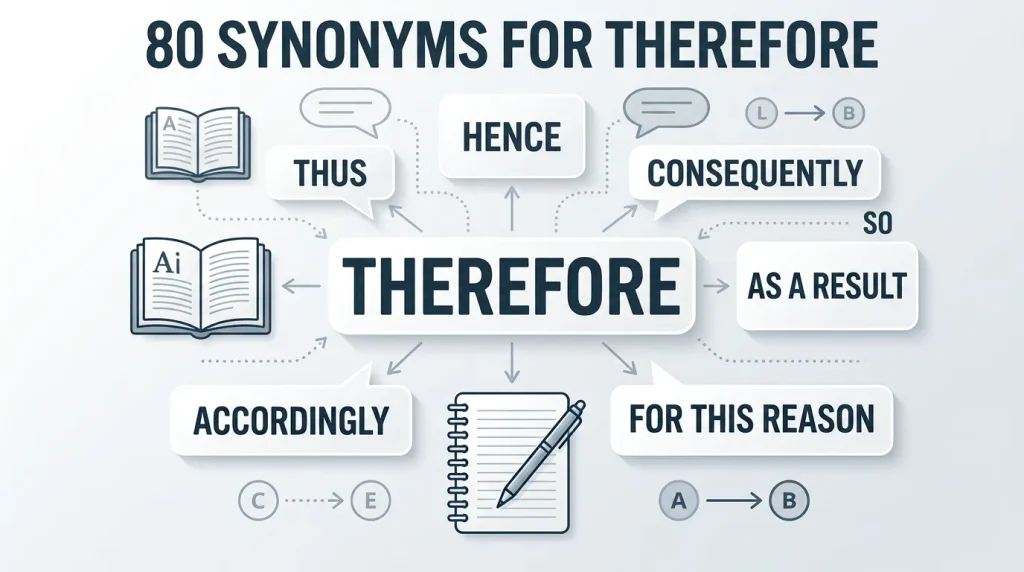
Common synonyms for therefore include thus, hence, consequently, accordingly, so, and for that reason. These words connect an action, fact, or event to its result. They help show that one idea follows another, making writing clearer, smoother, and easier for readers to understand.
The meeting ended early because everyone had finished the work. The manager smiled, packed her notes, and left the room. A small connecting word can make the next sentence flow naturally. This is where therefore and its alternatives become useful.
For example, you could write, “The road was closed; therefore, we took another route.” You could also choose another connecting word to make the sentence sound more natural or fit a different writing style.
Students can use these words to make essays clearer and show strong links between ideas.
Bloggers can use them to guide readers from one point to the next.
Content writers can use them to make explanations smooth and easy to follow.
Daily English users can use simple alternatives when speaking, texting, or writing messages.
“Clear words make clear ideas.”
Good word choice also helps you avoid using the same connector again and again.
“Small changes in language can make writing feel much stronger.”
80 Therefore Synonym
1. Thus
- Meaning: Thus shows that something happens because of an earlier fact.
- Examples: The shop was closed; thus, we waited.
She studied hard; thus, she passed.
2. Hence
- Meaning: Hence shows a result that comes from something already mentioned.
- Examples: It was raining; hence, the game stopped.
He was tired; hence, he rested.
3. Consequently
- Meaning: Consequently shows that one event causes a clear result.
- Examples: The bus broke down; consequently, we arrived late.
She missed practice; consequently, she lost her place.
4. Accordingly
- Meaning: Accordingly means something happens because of an earlier fact.
- Examples: The rules changed; accordingly, we updated everything.
The weather worsened; accordingly, plans were changed.
5. So
- Meaning: So shows a simple result and works well in everyday English.
- Examples: I felt hungry, so I cooked.
The door was locked, so we waited.
6. For That Reason
- Meaning: This phrase explains that something happened because of a stated reason.
- Examples: The road flooded; for that reason, we stayed home.
He was sick; for that reason, he rested.
7. As a Result
- Meaning: As a result introduces an outcome caused by something earlier.
- Examples: She practiced daily; as a result, she improved.
The storm arrived; as a result, flights stopped.
8. Therefore
- Meaning: Therefore connects a reason with the result that logically follows.
- Examples: The test was difficult; therefore, many struggled.
He was prepared; therefore, he felt confident.
9. That’s Why
- Meaning: That’s why gives a simple reason for something that happened.
- Examples: I was tired; that’s why I slept.
She forgot her key; that’s why she waited.
10. For This Reason
- Meaning: This phrase points back to a reason and introduces its result.
- Examples: The store was busy; for this reason, we waited.
He trained daily; for this reason, he improved.
11. Because of This
- Meaning: Because of this explains that something happens due to an earlier situation.
- Examples: The pipe broke; because of this, water spread.
She worked late; because of this, she slept late.
12. Due to This
- Meaning: Due to this connects an earlier situation with its direct result.
- Examples: The team practiced; due to this, skills improved.
Rain continued; due to this, roads flooded.
13. As Such
- Meaning: As such shows a result based on the situation already described.
- Examples: He was the leader; as such, he decided.
The room was private; as such, entry was limited.
14. In Consequence
- Meaning: In consequence means something happens as the result of another event.
- Examples: Costs increased; in consequence, prices rose.
He ignored advice; in consequence, problems followed.
15. Thereupon
- Meaning: Thereupon means something happened immediately after the stated event.
- Examples: The bell rang; thereupon, students left.
She heard the news; thereupon, she called home.
16. Wherefore
- Meaning: Wherefore can mean therefore, though it sounds old-fashioned today.
- Examples: The plan failed; wherefore, we stopped.
He broke the rule; wherefore, punishment followed.
17. For That Cause
- Meaning: This phrase links an outcome directly to a previously stated cause.
- Examples: The machine failed; for that cause, work stopped.
He lacked time; for that cause, he left.
18. On That Account
- Meaning: On that account means because of that particular reason or situation.
- Examples: She was busy; on that account, she declined.
The road was unsafe; on that account, we turned back.
19. For This Cause
- Meaning: For this cause explains why a result follows from an earlier condition.
- Examples: The soil was dry; for this cause, crops suffered.
He lacked funds; for this cause, he waited.
20. As a Consequence
- Meaning: As a consequence clearly introduces an outcome caused by something earlier.
- Examples: He ignored warnings; as a consequence, trouble followed.
Prices increased; as a consequence, sales dropped.
21. In Result
- Meaning: In result points toward an outcome produced by a previous action.
- Examples: The team trained hard; in result, players improved.
Rain continued; in result, fields became wet.
22. In Turn
- Meaning: In turn shows that one result leads naturally to another.
- Examples: She helped me, and I helped her in turn.
Sales grew and, in turn, profits increased.
23. Then
- Meaning: Then can show what happens next because of an earlier situation.
- Examples: Finish your work, then go home.
The alarm rang, then everyone moved.
24. So Then
- Meaning: So then connects a conclusion or next step to earlier information.
- Examples: The shop closed, so then we left.
You finished first, so then you could rest.
25. That Being So
- Meaning: This phrase introduces a result after accepting the previous situation as true.
- Examples: He was absent; that being so, we started.
The plan changed; that being so, we adapted.
26. In Light of This
- Meaning: This phrase introduces a decision based on information just presented.
- Examples: Costs rose; in light of this, we waited.
The data changed; in light of this, plans shifted.
27. In View of This
- Meaning: In view of this introduces an action based on earlier facts.
- Examples: The road flooded; in view of this, we stopped.
Demand fell; in view of this, production slowed.
28. With This in Mind
- Meaning: This phrase shows that an earlier fact guides the next action.
- Examples: Time was short; with this in mind, we hurried.
Money was limited; with this in mind, we saved.
29. For That Purpose
- Meaning: For that purpose connects an action with the goal described before.
- Examples: We needed clean water; for that purpose, we filtered it.
She wanted practice; for that purpose, she joined.
30. In That Case
- Meaning: In that case introduces what should happen under the stated condition.
- Examples: If you are tired, in that case, rest.
The store is closed; in that case, return tomorrow.
31. In That Event
- Meaning: In that event describes what follows if a certain situation happens.
- Examples: The storm may return; in that event, stay inside.
The flight could cancel; in that event, call us.
32. As a Consequence of This
- Meaning: This phrase directly links a stated situation with the result it creates.
- Examples: Demand increased; as a consequence of this, prices rose.
He missed training; as a consequence of this, progress slowed.
33. As a Result of This
- Meaning: This phrase clearly shows that one situation produces another outcome.
- Examples: Rain fell all night; as a result of this, roads flooded.
She practiced daily; as a result of this, confidence grew.
34. Following This
- Meaning: Following this introduces something that happens after the earlier event.
- Examples: The meeting ended; following this, everyone left.
The repair finished; following this, testing began.
35. Subsequently
- Meaning: Subsequently means something happened later because of an earlier event.
- Examples: The company changed owners; subsequently, policies changed.
He moved abroad; subsequently, they lost contact.
36. Thereafter
- Meaning: Thereafter means from that point forward after a stated event.
- Examples: The rule changed; thereafter, everyone complied.
She moved away; thereafter, visits became rare.
37. As a Result of That
- Meaning: This phrase points to an outcome caused by a previous situation.
- Examples: He missed class; as a result of that, work piled up.
The team lost; as a result of that, plans changed.
38. Because of That
- Meaning: Because of that gives a simple explanation for the following result.
- Examples: I missed breakfast; because of that, I felt weak.
She forgot the map; because of that, we got lost.
39. On That Basis
- Meaning: On that basis means a decision follows from given facts.
- Examples: The evidence was strong; on that basis, we agreed.
Costs were high; on that basis, we delayed.
40. Based on This
- Meaning: Based on this shows that an action follows from earlier information.
- Examples: Sales were low; based on this, we changed prices.
The test failed; based on this, we checked again.
41. In Accordance With This
- Meaning: This phrase shows that an action follows an earlier rule or decision.
- Examples: The policy changed; in accordance with this, we updated records.
Rules were revised; in accordance with this, staff acted.
42. For That Very Reason
- Meaning: This phrase strongly connects an action with the exact reason given earlier.
- Examples: Safety mattered; for that very reason, we stopped.
He valued honesty; for that very reason, he spoke.
43. By That Logic
- Meaning: By that logic introduces a conclusion that follows from earlier reasoning.
- Examples: Everyone needs rest; by that logic, workers do too.
Rules apply equally; by that logic, leaders follow them.
44. It Follows That
- Meaning: It follows that introduces a conclusion based on earlier facts or reasoning.
- Examples: All birds need air; it follows that they breathe.
The price increased; it follows that costs rose.
45. From This
- Meaning: From this shows that a conclusion comes from earlier information.
- Examples: From this, we learned an important lesson.
The results changed; from this, we knew.
46. Thusly
- Meaning: Thusly means in this way or as a result, but sounds uncommon.
- Examples: He explained the rule thusly to us.
The problem ended thusly after discussion.
47. In Turn, Therefore
- Meaning: This combination shows that one result leads naturally toward another conclusion.
- Examples: Sales increased, in turn, therefore profits grew.
Practice improved skills, in turn, therefore confidence increased.
48. And So
- Meaning: And so introduces a result in a simple, natural conversational way.
- Examples: It started raining, and so we left.
She felt tired, and so she rested.
49. So That
- Meaning: So that can connect an action with its intended result or purpose.
- Examples: Speak clearly so that everyone understands.
We left early so that traffic would not delay us.
50. For That Matter
- Meaning: For that matter can connect an additional point to earlier discussion.
- Examples: He dislikes tea, and coffee for that matter.
She knows math, and science for that matter.
How to Choose the Right Synonym for Therefore
Not every synonym for therefore sounds the same. Some are best for formal writing, while others fit daily speech. Thus, hence, consequently, and accordingly often appear in academic or professional writing. So and that’s why sound more natural in casual conversations.
Think about the tone before choosing a word. In an essay, “The evidence was weak; therefore, the claim was questioned” sounds clear and formal. In a conversation, “The bus was late, so I walked” feels more natural.
The key is not to replace therefore every time. Instead, choose the connector that matches your sentence, audience, and meaning.
Formal Alternatives to Therefore
Formal alternatives can make essays, reports, research writing, and business documents more varied. Words such as thus, hence, consequently, accordingly, and as a consequence clearly show logical connections.
For example, “The results were incomplete; therefore, more research was needed” can become “The results were incomplete; consequently, more research was needed.” Both sentences show a clear result, but the second has a slightly more formal feel.
Casual Alternatives to Therefore
In everyday English, simple expressions are often easier. So, that’s why, because of that, and and so work well in conversations, texts, and friendly messages.
For example, instead of saying, “The weather was poor; therefore, we stayed home,” you can say, “The weather was bad, so we stayed home.” The second version sounds more natural when speaking with friends or family.
Therefore in Academic Writing
Academic writing needs clear links between ideas. Therefore is useful when a conclusion follows from evidence, facts, or reasoning. However, repeating it in every paragraph can make writing sound dull.
Try using a mix of therefore, thus, consequently, hence, accordingly, and as a result. Always check the exact relationship between your ideas. A result connector should only be used when the second idea truly follows from the first.
Common Mistakes When Using Therefore
One common mistake is using therefore without a clear cause-and-effect relationship. Readers should be able to understand why the second statement follows the first.
Another mistake is placing the word awkwardly. For example, “He was tired therefore he slept” needs punctuation or a different structure. Better choices include “He was tired; therefore, he slept” or “He was tired, so he slept.”
It is also important to avoid unnecessary repetition. Good writing uses different sentence structures and connectors when they genuinely improve clarity.
“The best synonym is the one that fits the sentence.”
Conclusion:
Learning synonyms for therefore can make your English more flexible and your writing easier to read. You do not always need to use the same connector when you want to show a result. Words such as thus, hence, consequently, accordingly, as a result, and so give you more choices.
The most important step is understanding the small differences between these expressions. Some sound formal. Others are better for friendly conversations. Some focus on a clear result, while others show a reason, conclusion, or next step.
Students can use these alternatives to make essays smoother. Bloggers can use them to connect ideas without repeating the same word. Content writers can create better explanations. Daily English users can make messages and conversations sound more natural.
Try practicing a few words at a time. Write one sentence with therefore, then rewrite it using thus, consequently, or so. This simple exercise can quickly improve your word choice.
Use these words in emails, essays, blog posts, reports, and everyday conversations. With regular practice, choosing the right connector will become easier and more natural.
“Good writing connects every idea with care.”
The goal is not to use difficult words. The goal is to choose the right word for the right situation.
“Clear communication starts with simple, useful word choices.”

I am Emily Carter, a passionate writer at SynonymNexts.com, creating simple, helpful, and engaging content about synonyms and words.