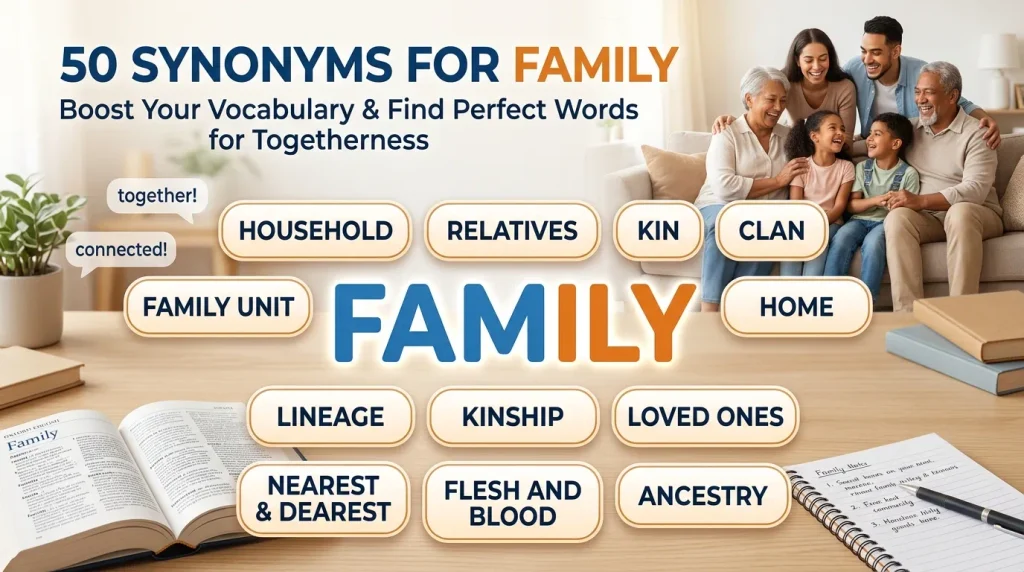
A synonym for “family” can be words such as relatives, household, kin, clan, kinsfolk, or loved ones. The best choice depends on your meaning. Some words describe people related by blood, while others describe people who live together, share a close bond, or feel like family.
At a Sunday dinner, everyone is talking at once. Your parents are laughing, cousins are sharing stories, and someone is already asking for more food. You may simply call them your family, but English gives you many other words for these people.
For example, you might write, “My relatives are visiting this weekend,” instead of saying, “My family is visiting.” Both sentences sound natural, but relatives gives the sentence a slightly different meaning.
Learning synonyms for family helps you avoid using the same word again and again. It can also help you choose a word that fits your exact idea.
Students can use these words in essays and schoolwork. Bloggers can make their writing more varied. Content writers can create smoother articles. Daily English users can sound more natural in conversations.
“The right word can make a simple message feel much clearer.”
A good synonym also helps you show the type of family connection you mean. You may want to talk about close relatives, a large household, ancestors, or people who feel like family.
“Warm words often help us describe the people closest to our hearts.”
50 Family Synonym
1. Relatives
- Meaning: Relatives are people connected to you through family relationships.
- Examples: My relatives live across the country.
We visit our relatives every summer.
2. Kin
- Meaning: Kin means people who are related to you by family.
- Examples: She invited her kin to dinner.
His kin helped during the move.
3. Household
- Meaning: A household means people who live together in one home.
- Examples: Everyone in our household loves music.
Our household stays busy all week.
4. Clan
- Meaning: A clan is a large group connected by family or ancestry.
- Examples: The clan gathered for a reunion.
Her clan has lived there for generations.
5. Kinsfolk
- Meaning: Kinsfolk means relatives or people connected through family ties.
- Examples: His kinsfolk welcomed us warmly.
Many kinsfolk attended the celebration.
6. Loved Ones
- Meaning: Loved ones are people who are very important and dear to you.
- Examples: She called her loved ones tonight.
His loved ones supported his dream.
7. Household Members
- Meaning: Household members are people who share the same home.
- Examples: All household members joined dinner.
Household members shared the chores.
8. Family Unit
- Meaning: A family unit is a group of people forming one family.
- Examples: Their family unit feels very close.
The family unit moved together.
9. Immediate Family
- Meaning: Immediate family usually means parents, children, siblings, or a spouse.
- Examples: Only my immediate family attended.
Her immediate family lives nearby.
10. Extended Family
- Meaning: Extended family includes relatives beyond parents, children, and siblings.
- Examples: Our extended family is huge.
Her extended family visits often.
11. Blood Relatives
- Meaning: Blood relatives are people connected through shared biological ancestry.
- Examples: He met his blood relatives.
Some blood relatives live overseas.
12. Relations
- Meaning: Relations means people who are connected to you through family.
- Examples: My relations came for lunch.
Her relations live in Canada.
13. Brood
- Meaning: Brood can describe a person’s children or a large family group.
- Examples: Their brood loves playing outside.
She raised a happy brood.
14. Tribe
- Meaning: Tribe can informally describe a close group that feels like family.
- Examples: My friends are my tribe.
Our little tribe loves camping.
15. Folks
- Meaning: Folks can casually mean your parents or family members.
- Examples: My folks are visiting today.
I called my folks after work.
16. Lineage
- Meaning: Lineage describes a person’s family line or ancestry.
- Examples: Her lineage goes back centuries.
He studied his family lineage.
17. Ancestry
- Meaning: Ancestry means the family background and people you came from.
- Examples: I enjoy learning about my ancestry.
Her ancestry includes many cultures.
18. Descendants
- Meaning: Descendants are people who come from an earlier family member.
- Examples: His descendants still live nearby.
The descendants gathered at the old home.
19. Offspring
- Meaning: Offspring means someone’s children or young family members.
- Examples: The couple raised three offspring.
Their offspring became successful adults.
20. Progeny
- Meaning: Progeny means someone’s children or later family members.
- Examples: His progeny carried his name.
The king’s progeny became leaders.
21. Household
- Meaning: Household can describe everyone living together under one home.
- Examples: Our household eats dinner together.
Their household welcomes many guests.
22. Kinfolk
- Meaning: Kinfolk is an informal word for relatives or family members.
- Examples: His kinfolk arrived early.
We shared stories with our kinfolk.
23. Kindred
- Meaning: Kindred refers to people connected by family, origin, or close ties.
- Examples: She met her kindred abroad.
His kindred supported the family.
24. Kindred Spirits
- Meaning: Kindred spirits are people who share similar feelings, ideas, or interests.
- Examples: We became kindred spirits quickly.
They felt like kindred spirits.
25. Family Circle
- Meaning: Family circle means the group of people who belong to your close family.
- Examples: She stayed within her family circle.
Everyone joined our family circle.
26. Relations Group
- Meaning: A relations group means people connected through shared family relationships.
- Examples: Our relations group meets yearly.
The relations group planned dinner.
27. Household Group
- Meaning: A household group is a set of people living together.
- Examples: Our household group shares chores.
The household group moved together.
28. Kin Group
- Meaning: A kin group is a group of people linked through family ties.
- Examples: The kin group met together.
Her kin group shared traditions.
29. Family Members
- Meaning: Family members are people who belong to the same family.
- Examples: My family members helped me.
Family members joined the celebration.
30. Close Relations
- Meaning: Close relations are family members with strong personal connections.
- Examples: My close relations live nearby.
She invited her close relations.
31. Dependents
- Meaning: Dependents are people who rely on another person for support.
- Examples: He supports two dependents.
Her dependents live with her.
32. Heirs
- Meaning: Heirs are people who may receive property or rights after someone dies.
- Examples: His heirs received the estate.
The heirs gathered after the announcement.
33. Successors
- Meaning: Successors are people who follow someone in a role or family position.
- Examples: His successors continued the work.
The family chose its successor.
34. Descendant Line
- Meaning: A descendant line shows people who come from earlier family members.
- Examples: We traced the descendant line.
The descendant line remains documented.
35. Family Branch
- Meaning: A family branch is one part of a larger family.
- Examples: Our family branch lives abroad.
Her family branch settled nearby.
36. Family Line
- Meaning: Family line means the people connected through generations of one family.
- Examples: His family line is well known.
She researched her family line.
37. Ancestral Line
- Meaning: An ancestral line connects you to people from earlier generations.
- Examples: He studied his ancestral line.
Their ancestral line began overseas.
38. Genealogy
- Meaning: Genealogy is the study or record of family relationships across generations.
- Examples: She studies genealogy for fun.
His genealogy revealed old connections.
39. Family Network
- Meaning: A family network is the wider group of connected family members.
- Examples: Our family network is large.
Her family network offered support.
40. Support System
- Meaning: A support system is a group that gives care, help, and encouragement.
- Examples: My family is my support system.
Her support system stayed close.
41. Inner Circle
- Meaning: An inner circle is a small group of people you trust deeply.
- Examples: He trusts his inner circle.
Her inner circle knows her well.
42. Loved Circle
- Meaning: A loved circle describes people who share a strong bond of care.
- Examples: She values her loved circle.
His loved circle stood beside him.
43. Home Group
- Meaning: A home group can describe people who share a home or close bond.
- Examples: Our home group eats together.
The home group planned a trip.
44. Family Community
- Meaning: A family community is a connected group that shares care and support.
- Examples: Their family community is welcoming.
The family community helped neighbors.
45. Household Circle
- Meaning: A household circle means the people who share a home and daily life.
- Examples: Everyone in our household circle helped.
Her household circle feels peaceful.
46. Kinship Group
- Meaning: A kinship group is a group connected through family relationships.
- Examples: The kinship group shared traditions.
Their kinship group gathered yearly.
47. Family Relations
- Meaning: Family relations are people connected through marriage, birth, or family ties.
- Examples: My family relations live nearby.
She called her family relations.
48. Household Family
- Meaning: Household family describes relatives or loved ones living together at home.
- Examples: Our household family eats together.
The household family shared responsibilities.
49. Family Members Group
- Meaning: This phrase describes several people who belong to one family.
- Examples: The family members group met.
Our family members group traveled together.
50. Family Circle
- Meaning: Family circle describes the close relatives and loved ones around you.
- Examples: Her family circle offered comfort.
He stayed close to his family circle.
How to Choose the Right Family Synonym
Not every synonym for family works in every sentence. Choose relatives when you mean people connected to you. Use household when you mean people living in the same home. Kin and kinsfolk sound more traditional, while folks feels casual.
For writing about ancestry, words such as lineage, ancestry, ancestral line, and genealogy are more precise. For emotional writing, loved ones, support system, and inner circle can better express closeness.
Synonyms for Family in Different Contexts
The best family synonym depends on your audience and purpose. In school writing, relatives, immediate family, extended family, and family members are clear choices. In casual conversation, folks and kin can sound natural.
For historical or cultural topics, clan, lineage, ancestry, and kinship group may fit better. In emotional writing, loved ones or support system can focus on care rather than biological connection.
“A strong vocabulary gives you more than words; it gives you more ways to express an idea.”
Family Synonyms for Formal Writing
Formal writing needs words that are clear and exact. Household works well when discussing people who live together. Immediate family clearly identifies close family members. Extended family is useful when talking about grandparents, aunts, uncles, cousins, and other relatives.
For history, research, and genealogy, lineage, ancestry, descendants, progeny, and kinship may be more suitable. Always check the exact meaning before replacing family with another word.
Family Synonyms for Casual Conversation
Everyday conversations often use simple words. You can say folks when talking about your parents, such as “My folks are coming tonight.” Loved ones works when you want to sound warm and caring.
You can also use relatives for a simple and common choice. Tribe and inner circle are informal options when talking about friends or people who feel very close to you.
How to Use Family Synonyms in Writing
Using different words can make your writing smoother, but you should not replace family every time it appears. Some synonyms have narrower meanings.
For example, ancestry refers to your background, while relatives refers to people. Household focuses on people living together. Loved ones focuses on emotional closeness. Choosing the right word makes your sentence more accurate.
A simple method is to ask what you really mean. Are you talking about people, home life, ancestry, family history, emotional support, or a close group? Your answer can guide your word choice.
Conclusion:
Learning synonyms for family can make your English more flexible and interesting. Instead of using the same word in every sentence, you can choose a word that gives your reader a clearer picture.
For example, relatives is useful when you mean family members. Household focuses on people who live together. Lineage and ancestry work well when discussing family history. Loved ones adds warmth, while folks gives a casual tone.
These choices are helpful in many areas. Students can use them to improve essays and assignments. Bloggers can make articles sound less repetitive. Content writers can choose more precise words. Daily English users can use them in texts, emails, and conversations.
Try practicing a few new words each day. Write a short sentence with relatives, then try another with kin, household, or loved ones. Over time, these words will feel natural.
“Good writing becomes stronger when every word has a clear purpose.”
You do not need to memorize all 50 at once. Start with five or ten that match your everyday needs. Then use them in emails, essays, captions, and daily conversations.
“The more useful words you learn, the easier it becomes to say exactly what you mean.”

I am Ryan Wilson, a passionate writer at SynonymNexts.com, sharing clear, useful, and engaging content about words, synonyms, and language.